Architecting for Performance & Consistency: Battle-Tested Data Patterns Across AWS, Azure, and GCP (Part 2/5)
Series Foreword: Demystifying Complex Cloud Systems Through Design Patterns
As an active Multi-Cloud Architect across AWS, Microsoft Azure, and GCP—having recently earned my Google Cloud Certified Professional Cloud Architect credential in July 2026 (See my achievement on Credly)—peers and aspiring cloud engineers often ask me the same fundamental question: "How do you design, reason about, and scale complex distributed architectures without getting lost in vendor-specific services and endless tooling?" My answer is always rooted in the core foundations of software engineering: Architectural Patterns. Cloud providers give us building blocks, but patterns provide the blueprint. Complex distributed systems are not tamed by adopting new cloud services at random, they are mastered by applying time-tested architectural principles—decoupling, isolation, graceful degradation, and resilience—elevated to infrastructure-level scale. To bridge the gap between abstract design principles and battle-tested production reality, I have authored this 5-part deep-dive series for cloud architects, software engineers, and distributed systems practitioners:
- Part 1/5: Scalability Patterns (Load Balancer, Pipes & Filters, Scatter-Gather, Execution Orchestrator, Choreography)
- Part 2/5: Performance & Data Consistency Patterns (MapReduce, Saga, Transactional Outbox, Materialized View, CQRS, Distributed CQRS with Materialized Views, Event Sourcing)
- Part 3/5: Software Extensibility Patterns (Sidecar & Ambassador, Anti-Corruption Layer, Backends For Frontends)
- Part 4/5: Reliability & Resilience Patterns (Retry with Exponential Backoff & Jitter, Circuit Breaker, Dead Letter Queue)
- Part 5/5: Modern Deployment & Resilience Validation Patterns (Rolling Deployment, Blue-Green Deployment, Canary Release & A/B Testing, Chaos Engineering)
Across each pattern, this series explores the foundational software design principles, critical architectural trade-offs, and failure recovery semantics, paired with concrete multi-cloud implementation matrices and real-world architectures spanning Amazon Web Services (AWS), Microsoft Azure, and Google Cloud Platform (GCP).
👉 In this edition, we dive into Part 2/5: Performance & Data Consistency Patterns.
Introduction: Navigating the Distributed Data Conundrum
In modern software engineering, achieving high performance across data-intensive systems extends far beyond upgrading hardware, adjusting thread pools, or scaling out relational read replicas. As distributed applications handle unprecedented data volumes, mission-critical mutations, and globally dispersed traffic, performance bottlenecks shift from raw compute boundaries to persistent storage I/O constraints, runtime relational join amplification, distributed coordination overhead, and transaction isolation deadlocks.
Like the architectural patterns that govern distributed scalability, modern data performance paradigms trace their intellectual roots back to classical systems and database research. Concepts first formalized decades ago—such as divide-and-conquer parallel batch processing from functional computing, long-lived non-blocking transactional coordination, append-only log-structured storage, and formal read/write responsibility segregation—have evolved from single-node mechanics into distributed, cloud-native primitives. The cloud has not supplanted foundational database theory; it has transformed these principles into resilient, horizontally distributed abstractions.
Without these deliberate architectural patterns, distributed systems inevitably succumb to costly operational anti-patterns: dual-write inconsistencies, thread starvation from runtime cross-service programmatic joins, destructive state overwrites, and severe lock contention under concurrent write spikes.
To master data throughput, transactional integrity, and low-latency retrieval systematically, software architects rely on seven battle-tested Performance Patterns engineered for modern cloud ecosystems:
- MapReduce Pattern: Abstracting large-scale distributed batch transformations into deterministic Map, Shuffle, and Reduce phases across decoupled compute and persistent storage.
- Saga Pattern: Maintaining eventual consistency across isolated microservice databases through orchestrated or choreographed sequences of local transactions and automated semantic compensations.
- Transactional Outbox Pattern: Guaranteeing reliable, at-least-once event publishing without the dual-write anti-pattern by atomically committing domain mutations and outbound payloads before asynchronous relaying.
- Materialized View Pattern: Eliminating repetitive, expensive runtime multi-table joins and aggregations by pre-computing read-optimized projections with sub-millisecond access profiles.
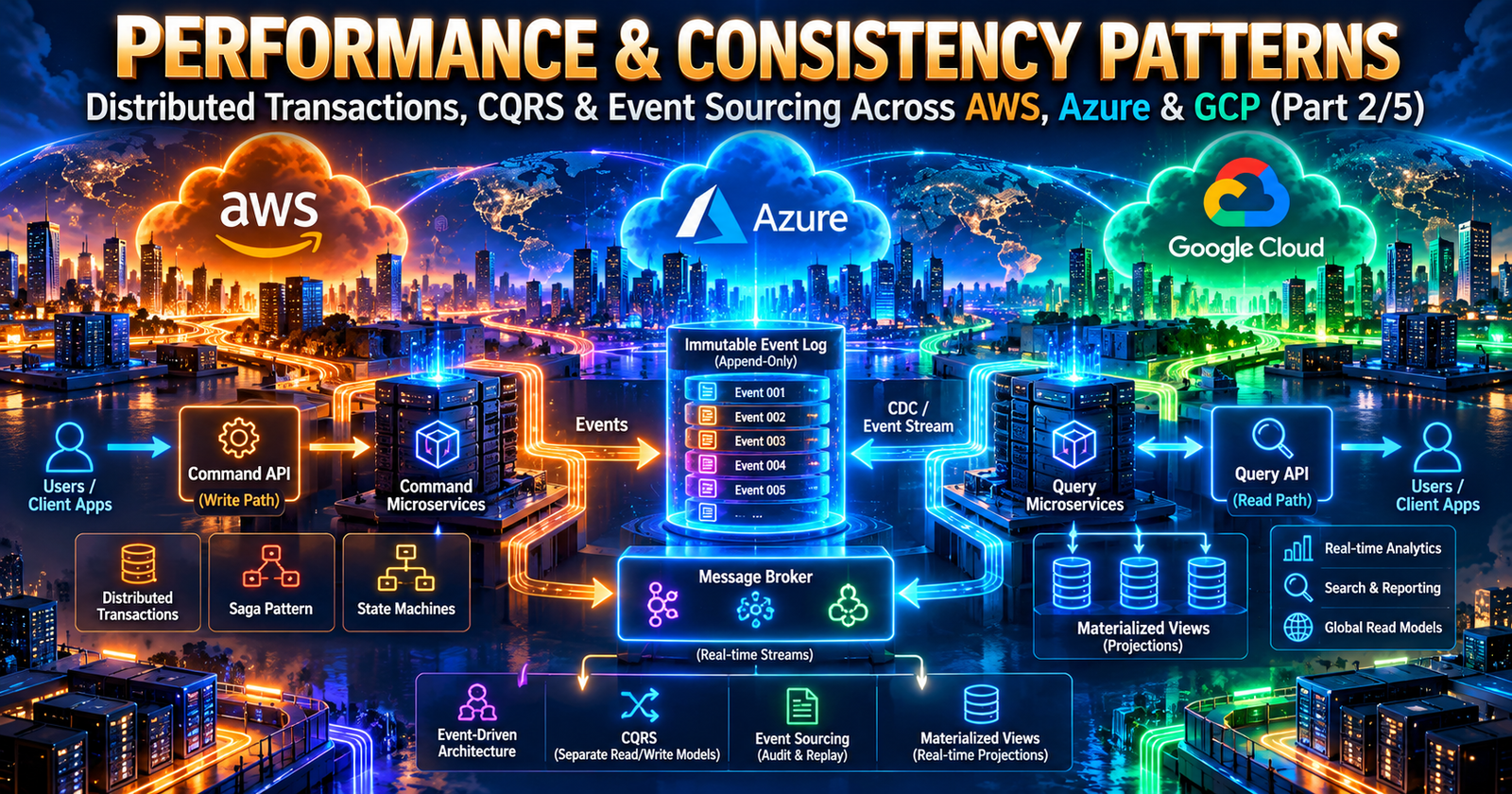
- Command and Query Responsibility Segregation (CQRS): Physically decoupling state-altering write operations from read-only data retrievals to achieve asymmetric scaling and schema specialization.
- Distributed CQRS with Materialized Views: Unifying bounded microservice contexts by asynchronously pre-joining scattered datasets into dedicated NoSQL read models via event-driven CDC pipelines.
- Event Sourcing Pattern: Eliminating write lock contention and state overwrite vulnerabilities by treating an immutable, append-only chronological log of domain events as the ultimate source of truth.
Across each pattern, this article examines core mechanics, systemic trade-offs, and failure recovery semantics, accompanied by cross-cloud implementation matrices and real-world architectures across Amazon Web Services (AWS), Microsoft Azure, and Google Cloud Platform (GCP).
Pattern 1: The MapReduce Pattern (Distributed Batch Analytics)
The MapReduce Pattern is the foundational paradigm for processing and generating massive datasets across distributed commodity compute clusters. Originating from Google's seminal 2004 research paper by Jeffrey Dean and Sanjay Ghemawat, the pattern abstracts the immense complexity of distributed systems—including data partitioning, task scheduling, inter-node shuffling, and fault recovery—into two straightforward functional programming primitives: Map and Reduce. By enforcing a strict key-value data pipeline, it allows organizations to scale data processing linearly across thousands of nodes without requiring custom distributed coordination logic.
1. Core Operating Principles
The MapReduce architecture standardizes large-scale batch transformations through a disciplined multi-stage execution model:
- Key-Value Transformation Pipeline:
- Input Stage: Massive datasets stored in durable distributed file or object storage are divided into fixed-size splits (blocks).
- Map Phase: The coordinator assigns data blocks to distributed Map Workers. Each worker executes the user-defined
map()function over raw records, emitting zero or more intermediate(Key, Value)pairs into local staging storage. - Shuffle and Sort Phase: The distributed engine groups and sorts all intermediate values by their respective intermediate keys. This ensures that every distinct key and its full collection of associated values are routed deterministically to the same reducer node.
- Reduce Phase: Distributed Reduce Workers execute the user-defined
reduce()function over each unique key and its iterator of values. The function calculates aggregated, summarized, or transformed results and writes the final datasets directly back to persistent storage.
- Infrastructure and Execution Abstraction: Developers only define data models and the mathematical logic for
map()andreduce(). The underlying engine takes care of scheduling, input data locality, network transmission, and result consolidation, eliminating repetitive low-level distributed plumbing. - Decoupled Compute and Elastic Batch Billing: Cloud implementations leverage decoupled compute-and-storage topologies. Organizations provision hundreds or thousands of worker instances on demand or on a schedule to complete batch processing in a short window, decommissioning the compute cluster immediately upon completion to avoid idle infrastructure costs.
2. Key Architectural Considerations & Trade-offs
- Worker Fault Tolerance and Dynamic Rescheduling: In large clusters running hundreds of machines, worker node crashes are routine rather than exceptional. The MapReduce coordinator continuously monitors worker health via heartbeats. If a Map Worker or Reduce Worker fails mid-computation, the coordinator automatically detects the failure and reschedules the impacted task split to an alternate, healthy worker instance without failing the overall job.
- Master Node High Availability (Single Point of Failure): The coordinator/master node orchestrates task execution, tracks intermediate file locations, and coordinates state transitions. While master crashes occur less frequently than worker node failures, an unhandled master crash can abort the entire job, incurring severe time and compute penalties from re-running lost computations. Production-grade architectures mitigate this risk through:
- Snapshot Storage & Replay Logs: Writing incremental job metadata checkpoints to persistent storage, allowing a newly initialized master to rebuild execution state.
- Active/Standby High Availability: Deploying redundant backup masters with automated leader election (e.g., via Apache ZooKeeper) to assume operational control immediately upon primary failure.
- Disk I/O and Network Bottlenecks: Intermediate
(Key, Value)pairs are materialized to disk and transferred across network switches during the shuffle phase. For iterative algorithms (such as machine learning training loops or graph traversal), this introduces substantial disk serialization and network serialization overhead compared to modern in-memory data processing engines (like Apache Spark). - Workload Suitability: MapReduce is optimal for bounded, high-volume batch workloads such as search engine inverted index construction, historical access log aggregation, large-scale ETL transformations, and distributed sorting. It is not designed for low-latency interactive querying or sub-second event-stream processing.
3. Cross-Cloud Implementation Matrix (AWS vs. Azure vs. GCP)
Cloud providers deliver MapReduce capabilities through managed Big Data platforms supporting Apache Hadoop and Apache Spark ecosystems, fully decoupled from persistent object storage layers:
| Architectural Component | Amazon Web Services (AWS) | Microsoft Azure | Google Cloud Platform (GCP) |
|---|---|---|---|
| Big Data / MapReduce Engine | Amazon EMR (Elastic MapReduce: Managed Hadoop, MapReduce, & Spark clusters; EMR Serverless for automated scaling without cluster management) | Azure HDInsight / Azure Synapse Analytics (Managed enterprise Hadoop & Spark clusters; Serverless Spark pools with auto-pause/resume) | Google Cloud Dataproc (Managed Service for Apache Spark & Hadoop; Rapid cluster provisioning in sub-minute; Dataproc Serverless for batch runtimes) |
| Durable Input & Output Storage | Amazon S3 (Integrated via EMRFS for compute/storage separation) | Azure Data Lake Storage Gen2 (ADLS Gen2: Hierarchical namespace integrated with Blob Storage) | Google Cloud Storage (GCS: Integrated via native GCS Cloud Storage Connector) |
| Intermediate Shuffle Storage | Local instance NVMe SSDs / Provisioned Amazon EBS volumes | High-performance Azure Premium SSDs / Ephemeral node storage | Local SSDs / Google Cloud Hyperdisk Extreme/Balanced |
| Master Node High Availability | EMR Multi-Master HA Cluster deployments + ZooKeeper | HDInsight Active & Standby Headnodes with automatic failover | Dataproc High Availability Mode (3 Master nodes + ZooKeeper) |
| Orchestration & Workflow Scheduling | AWS Step Functions / Amazon MWAA (Managed Apache Airflow) | Azure Data Factory / Synapse Pipelines | Google Cloud Composer (Managed Airflow) / Cloud Workflows |
4. Real-World Multi-Cloud Case Studies: Distributed Web Log Analytics & Inverted Indexing
A standard enterprise case study for MapReduce is periodic, high-volume web access log analysis to construct search index directories, detect security anomalies, and calculate usage metrics across terabytes of traffic data.
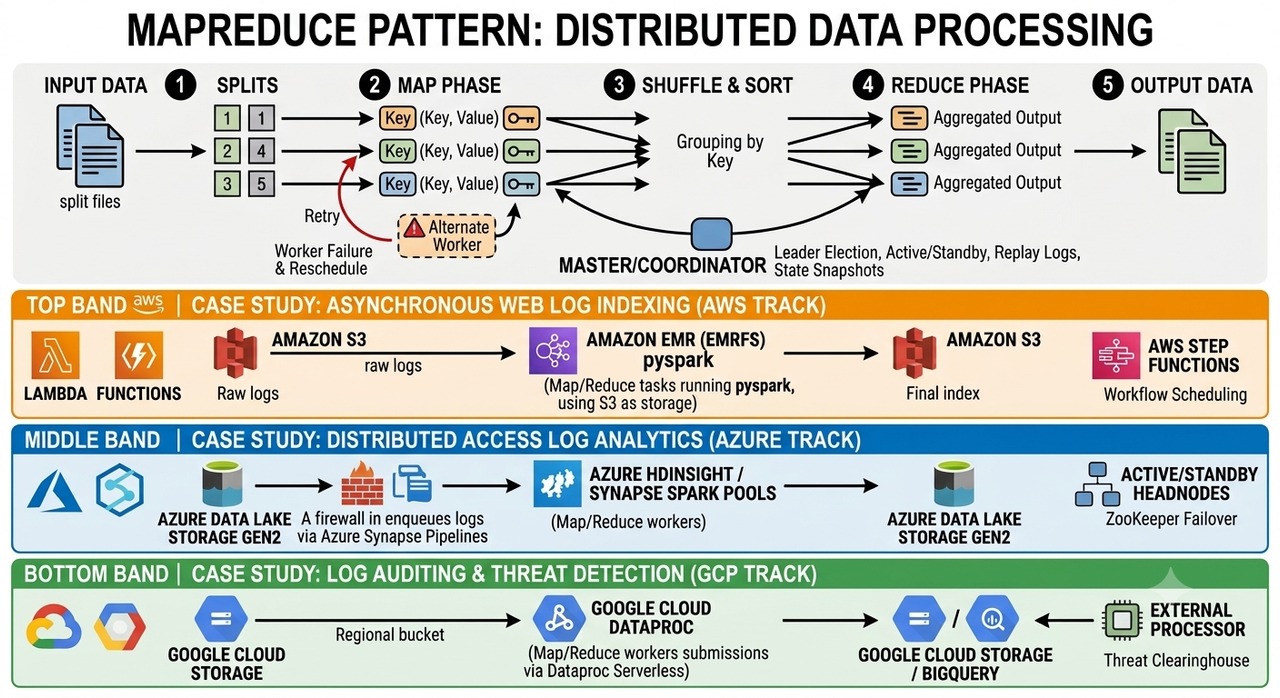
Figure 1: Cross-Cloud MapReduce Pattern Production Architectures Across AWS, Azure, and Google Cloud. (Source: Author's own illustration)
AWS Track: Asynchronous Web Log Indexing with Amazon EMR
- Ingestion & Durable Storage: Raw web server access logs are continuously delivered in compressed format into an Amazon S3 bucket.
- Cluster Instantiation: A scheduled AWS Step Functions workflow launches a transient Amazon EMR cluster with spot instances configured for task workers to optimize cost efficiency.
- Distributed Processing:
- Map Phase: Map Workers read log splits from S3 in parallel, parse web URI paths and status codes, and emit intermediate pairs where the key is the URI route and the value is a status counter.
- Shuffle & Sort: EMR coordinates the shuffle stage across local EBS volumes, grouping hits and status occurrences by URI.
- Reduce Phase: Reduce Workers aggregate total hits, calculate error rates per endpoint, and build an inverted index mapping keywords to accessed URLs.
- Result Storing & Teardown: Aggregated output files are written back to a dedicated S3 analytics prefix, and the temporary EMR cluster is automatically terminated to avoid paying for idle infrastructure.
Azure Track: Distributed Access Log Analytics with Azure HDInsight
- Ingestion & Durable Storage: Distributed application firewalls ingest audit logs into an Azure Data Lake Storage Gen2 (ADLS Gen2) account.
- Cluster Instantiation: An Azure Data Factory pipeline triggers an on-demand Azure HDInsight Hadoop cluster configured with dual Active/Standby headnodes for high availability.
- Distributed Processing:
- Map Phase: Mapper tasks distributed across worker nodes parse threat signatures and IP addresses from log partitions, writing intermediate outputs to local managed SSDs.
- Shuffle & Sort: Azure HDInsight organizes intermediate values by originating IP subnet and threat category.
- Reduce Phase: Reducers compute total incident frequencies, correlate geographical origins, and isolate anomalous ingress vectors.
- Result Storing & Teardown: The consolidated security index is saved to ADLS Gen2 for ingestion by security dashboards, followed by cluster deprovisioning.
GCP Track: Log Auditing & Threat Detection with Cloud Dataproc
- Ingestion & Durable Storage: Multi-terabyte crawled web page corpora reside in a Google Cloud Storage (GCS) regional bucket.
- Cluster Instantiation: A Google Cloud Composer DAG triggers a Dataproc Serverless batch workload, bypassing manual cluster node provisioning entirely.
- Distributed Processing:
- Map Phase: Serverless executors read raw documents directly via the Cloud Storage Connector, tokenizing words and emitting
(Word, Document_ID)pairs. - Shuffle & Sort: Google Cloud network infrastructure sorts and routes identical word keys to identical executor partitions.
- Reduce Phase: Reducers concatenate document references, sort positional indices, and construct the final inverted index dictionary.
- Map Phase: Serverless executors read raw documents directly via the Cloud Storage Connector, tokenizing words and emitting
- Result Storing & Teardown: The finished search index is committed back to Cloud Storage or exported to BigQuery for downstream search retrieval engines, with compute resources shutting down immediately upon execution completion.
Pattern 2: The Saga Pattern (Distributed Transactions & Data Consistency)
The Saga Pattern is an essential architectural pattern designed to manage distributed transactions and maintain eventual data consistency across decentralized microservice ecosystems. Originating in database research by Hector Garcia-Molina and Kenneth Salem in 1987, the pattern was originally formulated to handle long-lived transactions within centralized databases without holding persistent locks. In modern cloud and software architecture, it has been repurposed to solve the fundamental trade-off introduced by the Database-per-Microservice design model.
When breaking down monolithic systems into microservices, sharing a single relational database becomes an anti-pattern—creating a "distributed monolith" that impairs team autonomy, creates tight schema coupling, and causes deployment bottlenecks. However, giving each microservice its own dedicated database removes native database-level ACID transactions. The Saga pattern solves this dilemma by breaking an end-to-end distributed transaction into a sequence of isolated, local transactions spanning multiple services, backed by deterministic compensating operations in the event of upstream or downstream failures.
1. Core Operating Principles
The Saga pattern structures distributed state modifications across independently managed database instances using three foundational operational concepts:
- Decomposition into Local Transactions: A global business transaction spanning multiple services is split into a discrete sequence of N steps: \(T_1, T_2, \dots, T_n\). Each local transaction \(T_i\) executes within the boundary of a single service and commits state changes directly into that service's private database using local ACID guarantees.
- Compensating Transactions for Reversible Failures: Because distributed transactions commit intermediate states immediately, an error halfway through execution cannot rely on a traditional database rollback command. Instead, for each forward transaction \(T_i\), the system defines a compensating transaction \(C_i\) that semantically reverses the effects of \(T_i\). If transaction \(T_k\) fails, the saga invokes \(C_{k-1}, \dots, C_1\) in reverse order to restore consistent baseline states across all affected microservices.
- Pivot Operations and Forward Progression: A saga flow inherently reaches a designated Pivot Operation. If the pivot step completes successfully, the saga is considered committed: it will never execute backward compensation. Any failure after the pivot step is resolved via retries, idempotent background workers, or forward compensation rather than aborting the transaction.
2. Key Architectural Considerations & Trade-offs
- Solving the Distributed Monolith Anti-Pattern: Adopting a database per microservice is mandatory to achieve engineering velocity, schema isolation, and horizontal scale. The Saga pattern eliminates the dangerous need for shared monolithic databases or rigid two-phase commit (2PC) distributed locks, which destroy system throughput and cause network-bound deadlocks under heavy load.
- Lack of Isolation (The 'I' in ACID): The most critical trade-off in the Saga pattern is the loss of transaction isolation. Because local transactions commit changes before the overall saga finishes, concurrent operations may read "dirty" or intermediate data (e.g., viewing an event ticket marked as pending before the payment clears). Mitigating anomalies such as lost updates or non-repeatable reads requires defensive strategies: semantic locks (e.g., explicit status flags such as
pending,reserved,cancelled), commutative updates, and pessimistic versioning. - Execution Models (Orchestration vs. Choreography):
- Orchestrator-Based Saga: A dedicated stateful orchestrator explicitly invokes each participant service via synchronous API calls or asynchronous commands, waits for execution status, and directs compensating workflows if an error is encountered. This approach centralizes business logic, makes state inspectable, and simplifies error auditing.
- Choreography-Based Saga: Autonomous services publish domain events over an asynchronous message broker or event topic. Adjacent services reactively consume these events, perform their local operations, and emit new forward or backward compensation events. This maximizes decoupling and event-driven scalability, but increases distributed debugging complexity.
3. Cross-Cloud Implementation Matrix (AWS vs. Azure vs. GCP)
Cloud vendors supply specialized tools for executing stateful sagas via both centralized orchestration (state machines) and decoupled event streaming (topics and message queues):
| Architectural Component | Amazon Web Services (AWS) | Microsoft Azure | Google Cloud Platform (GCP) |
|---|---|---|---|
| Saga Orchestrator (State Machine) | AWS Step Functions (Visual ASL, built-in retry and catch blocks) | Azure Durable Functions / Logic Apps (Code-first orchestrations, try/catch handlers) | Google Cloud Workflows (Serverless YAML/JSON execution, error branching) |
| Choreography Messaging Backbone | Amazon SQS / SNS / EventBridge (FIFO queues, DLQ, rule-based filtering) | Azure Service Bus / Event Grid (Topic sessions, SQL filter rules, pub/sub) | Google Cloud Pub/Sub (Global event bus, push/pull subscriptions, DLQ routing) |
| Compute Execution Layer | AWS Lambda / Amazon ECS Tasks (Serverless microservice execution) | Azure Functions / Azure Container Apps (Queue/event triggered workers) | Google Cloud Run / Cloud Functions (Autoscaling containerized saga steps) |
| Isolated Microservice Databases | Amazon DynamoDB / Aurora PostgreSQL Serverless | Azure Cosmos DB / Azure SQL Database Serverless | Google Cloud Firestore / Cloud Spanner / Cloud SQL |
4. Real-World Case Study: Distributed Event Ticket Booking System
A real-world implementation of the Saga pattern is an Asynchronous Event Ticket Reservation System, coordinating multiple domain services and external third parties without a single shared datastore.
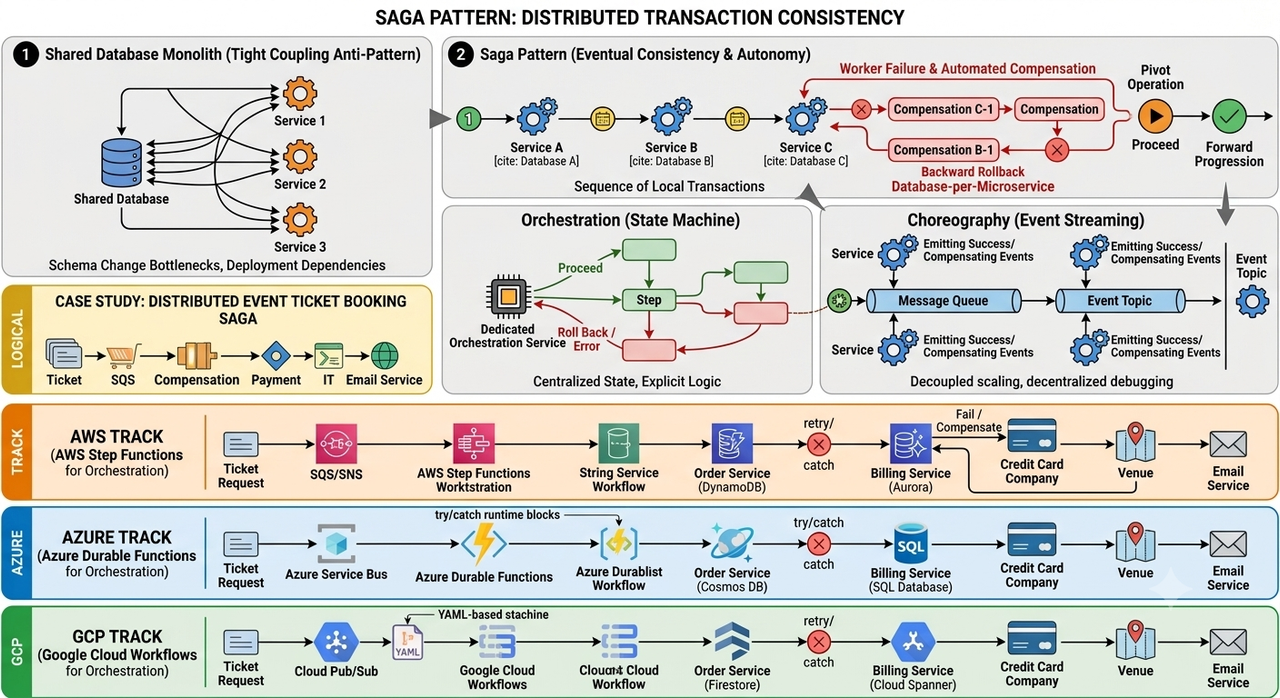
Figure 2: Saga Pattern Architecture: Shared Database Anti-Pattern vs. Distributed Saga Execution across AWS, Azure, and Google Cloud. (Source: Author's own illustration)
Step-by-Step Orchestrated Workflow
- Step 1: Order Initiation (Order Service)
- Forward Action: The user submits a purchase request. The Orchestrator calls the Order Service, which creates an order record marked with state
pendinginside its local database. - Failure Handling: If the database is unreachable, the orchestrator executes automated retries. If exhausted, it aborts the saga immediately without compensation.
- Step 2: Fraud & Blacklist Validation (Security Service)
- Forward Action: The orchestrator verifies that the user is not blacklisted and does not exhibit bot behavior.
- Compensating Action: If validation fails (e.g., bot detected), the Security Service returns a validation error. The orchestrator initiates rollback by calling the Order Service to remove or cancel the pending order.
- Step 3: Payment Authorization (Billing Service)
- Forward Action: The orchestrator invokes the Billing Service, which interfaces with an external credit card clearinghouse to authorize and create a pending charge.
- Compensating Action: If the card is declined or invalid, the external gateway rejects the transaction. The orchestrator issues a compensating call to the Order Service to delete the pending order record and aborts the flow.
- Step 4: Ticket Seat Allocation (Reservation Service) — Pivot Operation
- Forward Action: The orchestrator contacts the Reservation Service, which calls the external venue system to lock the designated seat. If confirmed, the seat is marked as
reservedin the local reservation database. - Compensating Action (Pre-Pivot Failure): If the venue reports the seat is unavailable, the step fails. The orchestrator triggers cascading compensation in reverse:
- Calls Billing Service to release the pending charge with the credit card company.
- Calls Order Service to cancel the pending order.
- Step 5: Transaction Commitment & Confirmation (Email Service)
- Forward Action (Post-Pivot): Once seat reservation and billing authorization succeed, the pivot operation is locked. The orchestrator instructs the Billing Service to capture funds (
charged), sets the order status in Order Service topurchased, and triggers the Email Service to send a confirmation ticket to the user. No compensation is allowed past this point; any communication dropouts are handled through background retries.
Multi-Cloud Reference Implementation Tracks
- AWS Track: Built around AWS Step Functions executing a state machine workflow. Each state invokes an AWS Lambda microservice interacting with its private Amazon DynamoDB table. The state machine utilizes native Retry arrays and catch blocks that branch into compensating Lambda invocations upon task failures.
- Azure Track: Built using Azure Durable Functions where an orchestrator function awaits activity functions representing the Order, Security, Billing, and Reservation domains. Persistence is maintained across separate Azure Cosmos DB containers. Reversals are handled directly within standard
try/catchruntime blocks executing compensating activities. - GCP Track: Built on Google Cloud Workflows orchestrating containerized microservices running in Google Cloud Run. Domain data resides independently in Cloud Firestore collections. Error states in the workflow trigger deterministic fallback steps that issue HTTP requests to reverse previously completed operations.
Pattern 3: The Transactional Outbox Pattern (Reliable Event Publishing)
The Transactional Outbox Pattern is a foundational enterprise integration pattern designed to achieve dependable, asynchronous event-driven communication across distributed systems. In modern decoupled microservice architectures, an upstream service frequently needs to mutate its local persistent state and broadcast a corresponding domain event to downstream subscribers via a message broker.
Attempting to execute these two operations sequentially introduces the dual-write problem: network partitions, broker downtimes, or host crashes between the local database write and the network dispatch leave the system in an inconsistent state. The Transactional Outbox pattern resolves this failure mode by leveraging local database transactions to persist both domain state changes and outbound messages atomically before an asynchronous relay decouples and guarantees message delivery.
1. Core Operating Principles
The Transactional Outbox pattern operates on atomic co-location of data and event payloads, followed by decoupled asynchronous extraction:
- Atomic Local Enlistment: Instead of publishing directly over the network to a message queue, the application writes the domain entity modifications and the corresponding message payload into the exact same database within a single local ACID transaction. In relational engines, this translates to writing to the business entity table and an auxiliary Outbox table. In NoSQL document stores, it is achieved by embedding an outbox attribute directly inside the aggregate root document.
- Asynchronous Message Relaying: A dedicated, decoupled background component—the Message Relay Service—monitors the outbox repository. It retrieves unpublished messages, dispatches them across the network boundary to the target message broker, and marks them as processed or deletes them from persistence upon broker acknowledgement.
- Decoupled Failure Domains: Transient outages or high latency spikes in the messaging infrastructure (such as Kafka, RabbitMQ, or cloud pub/sub topics) have zero operational blast radius on the core service's write availability. The local transaction succeeds independently of broker health.
2. Key Architectural Considerations & Trade-offs
- At-Least-Once Delivery Semantics: Relaying messages across distributed boundaries inevitably introduces transient failure vectors. If the relay service publishes an event to the message broker but terminates abruptly before marking the outbox record as sent or removing the document attribute, the subsequent relay worker re-reads the entry and retransmits it. As a direct result, the system guarantees at-least-once delivery, never exactly-once.
- Mandatory Consumer-Side Idempotence: Because duplicate events are unavoidable under at-least-once semantics, downstream consumers must be architected defensively:
- Naturally Idempotent Actions: State transitions that yield identical results regardless of invocation count (e.g., setting a user status to ACTIVE or overwriting an aggregate field) require no special deduplication logic.
- Non-Idempotent Actions: Critical operations with side effects (such as payment deductions via external credit card gateways or incremental counters) must attach a globally unique Event ID / Correlation ID generated at message conception. Downstream consumers maintain an idempotency store to detect previously processed message IDs, immediately dropping duplicates prior to invoking downstream or third-party APIs.
- Strict Chronological Ordering: High-frequency domain updates—such as an immediate User Registration followed rapidly by a User Cancellation—create race conditions if the relay service polls and batches outbox records non-deterministically. To prevent downstream services from applying a registration event after a cancellation, outbox records must be stamped with a monotonically increasing Sequence ID or monotonic logical version, paired with FIFO-enforced message topics.
- Relay Ingestion Mechanics (Polling vs. Transaction Log Mining):
- Polling Publisher: The relay issues periodic
SELECT FOR UPDATE SKIP LOCKEDqueries against relational outbox tables, or queries documents containing an outbox attribute in NoSQL databases. While simpler to implement, frequent polling introduces query overhead and polling latency. - Transaction Log Tailing (Change Data Capture / CDC): The relay inspects the database engine's low-level commit log (such as PostgreSQL WAL, MySQL Binlog, DynamoDB Streams, or MongoDB Change Streams) via CDC tools like Debezium. This eliminates polling overhead, delivering sub-second event relaying directly from committed storage.
3. Cross-Cloud Implementation Matrix (AWS vs. Azure vs. GCP)
Cloud providers offer both serverless relational databases and distributed NoSQL platforms, each pairing natively with tailored streaming pipelines and queue services:
| Architectural Component | Amazon Web Services (AWS) | Microsoft Azure | Google Cloud Platform (GCP) |
|---|---|---|---|
| Relational Outbox Tier | Amazon Aurora PostgreSQL Serverless (Dedicated outbox table updated within local ACID transaction blocks) | Azure Database for PostgreSQL Flexible Server (Relational table storing payloads, headers, and sequence counters) | Cloud SQL for PostgreSQL (ACID table write with transactional row locking) |
| NoSQL Embedded Document Tier | Amazon DynamoDB (Single-item atomicity via embedded outbox attributes inside item maps) | Azure Cosmos DB (Single-partition point writes persisting embedded JSON arrays) | Google Cloud Firestore / Datastore (Document-level atomic commit containing event payload fields) |
| Message Relay Mechanism (CDC / Polling) | AWS Lambda + DynamoDB Streams / Amazon EventBridge Pipes (Native CDC stream capturing item changes with automatic event filtering and forwarding) | Azure Functions + Cosmos DB Change Feed (Event-driven consumer scaling out on partition key ranges to read outbox entries) | Google Cloud Run / Eventarc + Cloud Storage/Firestore triggers (Containerized relay listening to database commit streams) |
| Target Messaging Backbone | Amazon SQS FIFO / Amazon SNS FIFO / Amazon EventBridge (Strictly ordered message queues with built-in deduplication IDs) | Azure Service Bus (FIFO Queues & Topics) (Enterprise message broker supporting Message Sessions and duplicate detection windows) | Google Cloud Pub/Sub with Ordering Keys (Scalable distributed pub/sub enforcing per-entity ordering via partition keys) |
| Downstream Deduplication Store | Amazon DynamoDB (Conditional puts on Event ID with TTL expiration) | Azure Cosmos DB / Redis Cache (Atomic conditional inserts for idempotency keys) | Google Cloud Memorystore / Cloud Bigtable (Key-value lookup on incoming Event UUID) |
4. Real-World Case Study: Asynchronous User Onboarding & Multi-Service Propagation
Consider a high-throughput Job Search Platform where new user onboarding triggers secondary downstream workflows (Search Indexing, Notification Scheduling, and Billing Activation) across autonomous microservice boundaries.
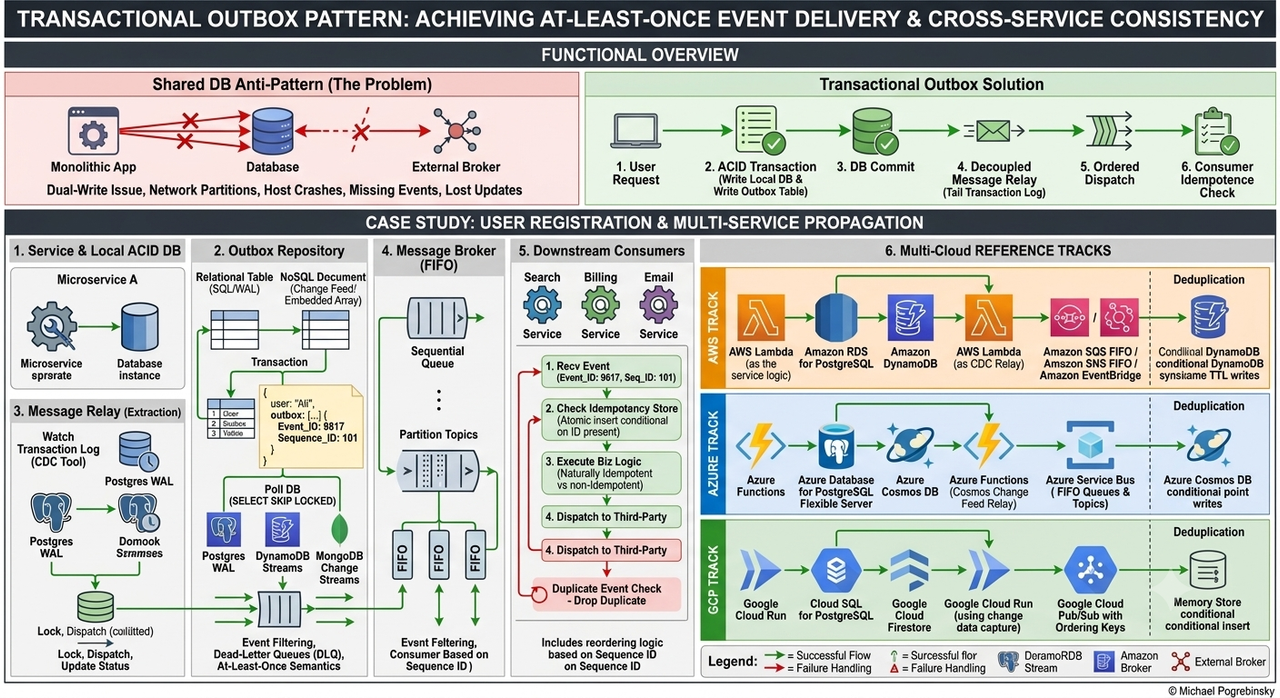
Figure 3: Transactional Outbox Pattern: Achieving At-Least-Once Event Delivery & Cross-Service Consistency across AWS, Azure, and Google Cloud. (Source: Author's own illustration)
End-to-End Operational Lifecycle
- Step 1: Local State & Outbox Persistence
- The end user signs up via the frontend application.
- The User Service initializes a local database transaction. It writes the profile details to the primary user repository and inserts the
UserCreatedmessage payload into an internal outbox structure. - Relational Approach: Inserts into
userstable andoutbox_eventstable simultaneously within the same transaction. - NoSQL Approach: Writes a single JSON document containing user attributes and an embedded outbox array element with a unique
Event_ID: 9817andSequence_ID: 101. - The transaction commits locally. Network dropouts between the service and external brokers have zero impact on the registration commit.
- Step 2: Relay Observation & Pipeline Ingestion
- The decoupled Message Relay Service tracks newly committed entries.
- Under a CDC pattern: The database stream automatically dispatches the uncommitted change records to the relay runtime.
- Under a polling pattern: The relay executes a filtered batch query for records pending dispatch, locks the batch, and extracts the payload.
- Step 3: Ordered Dispatch to the Message Broker
- The relay formats the event payload, attaching headers for
Event_ID,Sequence_ID, and the routing partition key (User_ID). - It transmits the event to an ordered messaging topic (e.g., SQS FIFO, Service Bus Topic, or Pub/Sub with ordering keys).
- Upon receiving an explicit acknowledgement (ACK) from the broker, the relay either deletes the outbox record, flips an internal status flag to
DISPATCHED, or removes the outbox attribute from the NoSQL document. - Step 4: Downstream Idempotent Processing
- Scheduling Service (Naturally Idempotent): Receives the event and configures search alerts. Re-delivery of the event overwrites identical alert parameters without state corruption.
- Billing Service (Non-Idempotent External Action): Receives the event and needs to authorize a trial membership fee with a third-party payment gateway. The consumer extracts
Event_ID: 9817and attempts an atomic check-and-set operation in its local database. If the ID is already present, the duplicate event is immediately discarded, preventing double-billing. - Step 5: Sequential Reordering & Fault Recovery
- If the user immediately deactivates the account, a
UserDeactivatedevent (Sequence_ID: 102) is committed to the outbox. - The broker preserves message sequence via partition hashing on
User_ID, ensuring the downstream services process creation prior to deactivation, preventing orphan account states.
Architectural Deep Dive: Understanding the Relay and the Broker
The Message Relay and the Message Broker operate as a collaborative pair to ensure distributed consistency during asynchronous workflows, such as user registration via the User Service.
The Concrete Use Case: User Registration
When a client creates an account on the platform, the User Service must execute two critical operations:
- Persist the Domain Entity: Insert the user profile directly into its dedicated database table or document (
UsersTable). - Notify Downstream Domains: Downstream microservices depend on this state transition to execute their respective domain logic:
- Billing Service: Initializes the customer's billing ledger or triggers trial subscription provisioning.
- Scheduling / Search Service: Indexes the profile and configures automated job alert schedules.
- Email Service: Emits account confirmation links and onboarding credentials.
Why Decouple Database Writes from Direct Broker Dispatch?
If the User Service commits to its database and immediately attempts an over-the-network call to the broker, transient network partitions or unexpected node crashes can result in irreversible event loss. To eliminate this vulnerability, the service never publishes to the broker directly over the network: it writes the user profile and enqueues the outbound event payload into its local Outbox table within a single, atomic ACID transaction.
The Role of the Message Relay Service
The Message Relay Service is an autonomous background component:
- Continuous Surveillance: It monitors the local Outbox repository within the database engine.
- Payload Extraction: As soon as an uncommitted message appears—detected via periodic polling or native Change Data Capture (CDC) streams such as Postgres WAL or DynamoDB Streams—the relay reads and locks the record.
- Network Ingestion: It transmits the extracted payload across the network boundary directly into the Message Broker.
- State Reconciliation: Upon receiving an explicit acknowledgment (ACK) from the broker, the relay marks the record as processed (
Mark sent) or purges it from local storage.
The Role of the Message Broker
The Message Broker acts as the centralized distribution hub:
- Decoupled Delivery Hub: It ingests incoming messages dispatched by the upstream relay.
- Topic Subscription & Fan-Out: It routes and delivers event copies exclusively to subscribed downstream services (Billing, Scheduling, Search, etc.).
- Buffer & Fault Tolerance: If a consumer service experiences transient downtime or processing lag, the broker safely retains incoming events, ensuring resilient asynchronous ingestion when the consumer recovers.
In simple terms: the core application places its letter inside its own local mailbox (Outbox), the Relay acts as the postal worker extracting the letter to transport it, and the Broker functions as the sorting center dispatching copies of that letter to all recipient services.
Pattern 4: The Materialized View Pattern (Query Performance & Cloud Cost Optimization)
The Materialized View Pattern is an optimization strategy engineered to overcome the latency and throughput bottlenecks inherent in executing resource-intensive, ad-hoc queries over large datasets. In conventional data architectures, queries requiring multi-table joins (JOIN), aggregations (SUM, COUNT, AVG), and complex filters are computed dynamically at runtime. As data volumes scale, these repetitive calculations place severe strain on database compute resources, introduce unacceptable end-user latency, and drastically increase cloud infrastructure costs.
The Materialized View pattern resolves this inefficiency by pre-computing, storing, and maintaining the results of expensive queries in a dedicated, read-optimized tabular format or secondary document store. By substituting runtime compute with inexpensive physical storage, downstream consumers bypass the underlying raw data repositories entirely, querying direct projections with predictable, sub-second response profiles.
1. Core Operating Principles
- Pre-Computation and Physical Ingestion: Unlike a standard virtual database view—which merely encapsulates a saved SQL query executed against source tables upon each access—a materialized view physically stores the resulting dataset on disk or memory.
- Decoupling Read and Write Topologies: By serving read traffic from a pre-materialized table, the primary transactional tables (Raw Data Tables) remain shielded from intensive scanning operations. This segregation ensures transactional workloads (OLTP) avoid resource contention caused by analytical reporting or dashboard generation.
- Synchronization Strategies: Because the underlying source entities mutate over time, materialized views rely on targeted synchronization mechanisms:
- Change Data Capture (CDC) / Event-Driven: Database write streams or application domain events trigger real-time updates directly to the materialized projection.
- Incremental Delta Updates: Only the records modified since the previous cycle are recomputed, avoiding full-table recalculation.
- Scheduled Batch Refresh: Suitable for scenarios where eventual consistency is acceptable, executing automated point-in-time updates.
2. Key Architectural Considerations & Trade-offs
- Eventual Consistency and Data Staleness: Storing pre-computed results introduces a deliberate trade-off between freshness and query performance. While transactional mutations execute immediately on the primary entity, there is an inherent propagation lag before the materialized projection reflects the newest state.
- Storage and Compute Maintenance Overhead: While query execution costs decrease, background ingestion pipelines, secondary storage capacity, and indexing overhead consume system resources. Architects must balance the operational cost of continuous materialization against the frequency and urgency of query requests.
- Alignment with CQRS (Command Query Responsibility Segregation): The Materialized View pattern functions as a foundational primitive for the "Query" side of a CQRS architecture, projecting multi-service event logs into domain-tailored read models.
3. Cross-Cloud Implementation Matrix (AWS vs. Azure vs. GCP)
| Architectural Component | Amazon Web Services (AWS) | Microsoft Azure | Google Cloud Platform (GCP) |
|---|---|---|---|
| Relational / Analytical Data Warehousing | Amazon Redshift / Aurora PostgreSQL (Automated materialized views with AUTO REFRESH on incremental deltas, Native MATERIALIZED VIEW syntax) | Azure Synapse Analytics / Azure SQL Database (Automated materialized views caching complex T-SQL aggregations, Smart query optimizer rewriting) | Google BigQuery (Zero-maintenance serverless materialized views, Smart Tuning, and automatic query rewriting) |
| NoSQL Stream-Based Materialization | Amazon DynamoDB + Streams & Lambda (Global Secondary Indexes [GSI] with projection keys, Lambda triggered by DynamoDB Streams to populate read models) | Azure Cosmos DB + Change Feed & Functions (Container-to-container continuous projections via Azure Functions consuming the Change Feed) | Google Cloud Firestore / Bigtable + Cloud Run (Eventarc and Firestore triggers generating aggregated read documents in secondary collections) |
| In-Memory Caching Acceleration | Amazon ElastiCache (Redis / Valkey) (Materialized JSON payloads indexed directly by lookup key) | Azure Cache for Redis (Pre-aggregated cache objects serving sub-millisecond retrieval) | Google Cloud Memorystore (Read-replica distributed caching layer for structured aggregates) |
4. Real-World Case Study: Global E-Commerce Analytics Dashboard
Consider a high-traffic e-commerce platform processing hundreds of millions of order lines, inventory changes, and customer transactions daily. The executive team and merchant portal require real-time summaries detailing Total Revenue per Category, Top Performing Merchants, and Inventory Turnaround Rates.
The Anti-Pattern: On-Demand Querying
Whenever a merchant loads their portal, the dashboard service executes an aggregate query:
SELECT category_id, SUM(order_amount), COUNT(order_id)
FROM raw_orders
GROUP BY category_id;
Scanning millions of rows locks critical disk I/O, spikes memory, increases latency to tens of seconds, and exhausts database connection pools.
The Materialized Architecture
- Primary order writes commit directly to the transactional
raw_orderstable (OLTP). - A transactional commit log (e.g., PostgreSQL WAL or DynamoDB Streams) streams raw change records asynchronously.
- A lightweight streaming worker or native database engine increments the pre-aggregated summary in a dedicated
category_metrics_summarytable.
The query executed by the Merchant Portal becomes a simple key-based read:
SELECT * FROM category_metrics_summary WHERE category_id = 'CAT-44';
Query complexity drops from an O(N) multi-table scan down to an O(1) single-key index lookup, slashing latency from 15 seconds to under 10 milliseconds and eliminating repeated compute overhead.
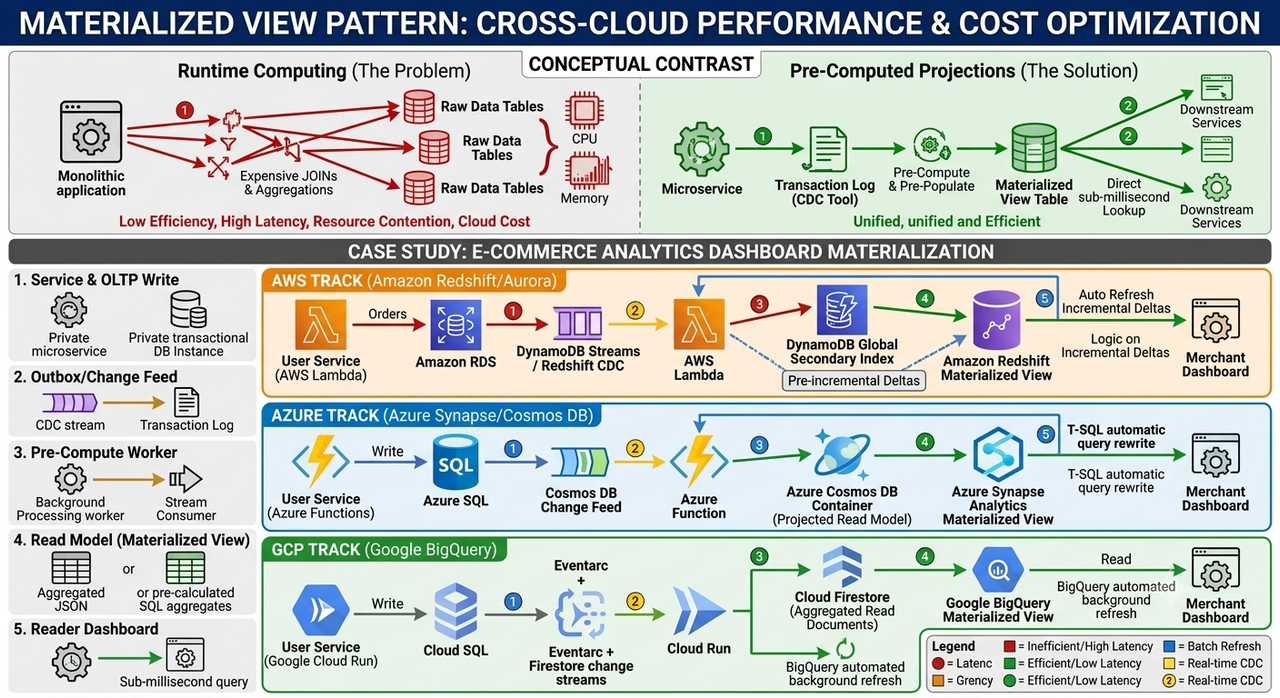
Figure 4: Materialized View Pattern: Cross-Cloud Performance & Cost Optimization Across AWS, Azure, and Google Cloud. (Source: Author's own illustration)
5. Architectural Deep Dive: Polyglot Materialization and Event Sequencing
The multi-cloud comparative architecture illustrates a sophisticated implementation of the Materialized View pattern designed for an E-commerce Analytics Dashboard. A key observation in this architecture is the deliberate mixing of SQL and NoSQL technologies within a single data flow, alongside targeted strategies to maintain strict event sequencing.
1. Polyglot Persistence: Why Mix SQL and NoSQL?
A conventional materialized view is a saved, pre-computed SQL query result stored in a relational engine like BigQuery, Synapse, or Redshift. However, in cloud-native distributed systems, the term "Materialized View" describes any pre-computed projection tailored for a specific read model, regardless of the underlying storage technology.
This architecture implements polyglot persistence across three distinct stages:
- Source Tier (Transactional SQL): Order transactions commit first to an ACID-compliant SQL engine (e.g., Cloud SQL on GCP, Amazon RDS, or Azure SQL). Relational databases remain the gold standard for OLTP (Online Transactional Processing) workloads because their transactional boundaries guarantee that order lines, payments, and inventory deductions are never corrupted.
- Decoupled Worker Tier: The core transactional application remains completely decoupled from aggregation and indexing logic. Autonomous worker runtimes (such as Google Cloud Run, AWS Lambda, or Azure Functions) consume committed transaction logs and compute targeted projections asynchronously.
- Destination Read Models (Dual Storage Optimization):
- To NoSQL Document Stores (e.g., Cloud Firestore, DynamoDB, Cosmos DB): The worker computes low-latency aggregates (e.g., Total Revenue per Category Today) and persists them as denormalized documents. NoSQL document stores excel at delivering high-concurrency, sub-millisecond point lookups for thousands of concurrent merchant dashboards.
- To Analytical Warehouses (e.g., Google BigQuery, Amazon Redshift, Azure Synapse): Simultaneously, change streams feed into analytical data warehouses to maintain native materialized views. These engines process complex, long-running queries across historical petabytes without competing for compute or memory with transactional OLTP instances.
2. Event Sequencing: Maintaining Chronological Integrity
A foundational challenge in distributed materialization is maintaining sequential integrity. If an order creation event is immediately followed by an order cancellation or modification, processing the modification first creates an invalid read model state.
The end-to-end pipeline preserves chronological integrity across five stages:
- Source Commit (1): Transactional mutations (
Create Order,Modify Order) write sequentially to the database write-ahead log (WAL / commit log), locking in strict chronological order. - Ordered Capture (CDC): The Change Data Capture pipeline (e.g., DynamoDB Streams, Cosmos DB Change Feed, Eventarc) extracts change records in the exact sequence they were committed.
- Ordered Transport (FIFO Broker): Change events flow through an ordered messaging backbone (such as SQS FIFO, Azure Service Bus Message Sessions, or Pub/Sub with Ordering Keys) that guarantees First-In, First-Out delivery per partition key (
Order_ID). - Ordered Processing (2) (Worker Fleet): The worker runtime processes events in strict sequence per partition key, eliminating race conditions between concurrent worker threads.
- Ordered Materialization (3): The projection updates deterministically—creating the aggregated record upon receiving
Create, and mutating the existing summary upon receivingModify.
Sequential integrity is never accidental; it is strictly enforced end-to-end by aligning the database transaction log, a FIFO-capable message broker, and ordered consumer processing.
Pattern 5: Command and Query Responsibility Segregation (CQRS)
The Command and Query Responsibility Segregation (CQRS) software architecture pattern formally separates the data mutation model (Commands) from the data retrieval model (Queries). In conventional monolithic or layered service architectures, a unified data model handles both write and read operations against a single database schema. This centralized model creates resource contention, forces complex compromises in database normalization, and limits scalability when read traffic heavily outpaces write traffic.
CQRS addresses these constraints by decoupling the pipeline into two autonomous subsystems with dedicated logical and physical data models: the Command Side, optimized for state mutations, domain logic validation, and transactional integrity; and the Query Side, designed for fast data retrieval via denormalized, join-free projections.
1. Core Operating Principles
- Strict Role Segregation (Commands vs. Queries):
- Command Side: Handles all state-altering operations (Insert, Update, Delete). It encapsulates complex domain logic, validation rules, and authorization policies.
- Query Side: Executes read-only requests (Query) without altering system state. It focuses on efficient data retrieval and serialization.
- Independent Evolution and Deployment: Because the command and query paths are decoupled, business rules in the Command Service can be updated and released without touching or redeploying the Query Service. Engineering teams can maintain, optimize, and iterate each service independently.
- Polyglot Storage and Schema Specialization:
- The Command DB uses a write-optimized database engine and schema, typically a normalized relational database designed to guarantee ACID transactions and prevent data anomalies.
- The Query DB employs a read-optimized store, often a NoSQL document database configured with denormalized collections for fast indexed reads without runtime joins.
- Asynchronous Synchronization Pipelines: Synchronizing state mutations from the Command DB to the Query DB occurs asynchronously using either a Message Broker or serverless event-driven compute (Function As A Service / FaaS). To prevent the dual-write problem across boundaries, the Command Side can incorporate the Transactional Outbox Pattern: the service persists domain changes and outbox event payloads within the same local ACID transaction before an asynchronous relay publishes them to the broker.
2. Key Architectural Considerations & Trade-offs
- Eventual Consistency: Physical segregation between the command and query datastores means replication introduces propagation latency. The Query DB reflects changes with a slight delay, requiring downstream consumers and user interfaces to accommodate eventual consistency.
- Operational Overhead and System Complexity: Running CQRS requires provisioning, monitoring, and maintaining two distinct application services, two independent datastores, and an automated synchronization pipeline. Architects must evaluate whether query throughput demands justify this additional operational cost.
- Asymmetric Elastic Scaling: CQRS allows independent horizontal scaling of compute and storage. Because read workloads often account for the vast majority of application traffic, the Query Service and read replicas can scale aggressively behind a dedicated load balancer, while the Command Service and write database remain moderately provisioned.
3. Cross-Cloud Implementation Matrix (AWS vs. Azure vs. GCP)
| Architectural Component | Amazon Web Services (AWS) | Microsoft Azure | Google Cloud Platform (GCP) |
|---|---|---|---|
| Command Engine (OLTP & ACID Writes) | Amazon Aurora PostgreSQL / RDS (Fully managed relational database for ACID compliance, foreign key constraints, and transactional outbox tables) | Azure Database for PostgreSQL Flexible Server (Relational database ensuring strict domain validation and ACID transactions) | Google Cloud SQL for PostgreSQL / Cloud Spanner (Relational persistence engine enforcing transactional consistency) |
| Synchronization Pipeline (Broker / FaaS) | AWS Lambda + Amazon SQS/SNS FIFO or DynamoDB Streams (Serverless functions triggered on database change logs; FIFO messaging to maintain ordering) | Azure Functions + Azure Service Bus FIFO or Cosmos DB Change Feed (Event-driven functions reacting to committed writes; session-based ordering) | Google Cloud Functions / Cloud Run + Cloud Pub/Sub (Eventarc triggers executing serverless handlers on mutation events; Pub/Sub with ordering keys) |
| Query Engine (Read-Optimized Models) | Amazon DynamoDB / OpenSearch Service (Denormalized document collections for sub-millisecond key-value lookups) | Azure Cosmos DB (Core SQL API) (Globally distributed NoSQL store serving pre-aggregated read views) | Google Cloud Firestore / Cloud Bigtable (Low-latency document store for join-free client dashboard queries) |
| Independent Ingress & Load Balancing | AWS Application Load Balancer (ALB) routing independently to ECS/EKS clusters | Azure Application Gateway distributing traffic across containerized instances | Google Cloud Load Balancing providing segregated routing for read and write endpoints |
4. Real-World Case Study: E-Commerce Product Reviews and Ratings
Consider an online retail platform where product pages experience high browsing volumes while product reviews and ratings are submitted comparatively infrequently.
+----------------------------------------------------+
|                    COMMAND SIDE                    |
| [User] ---> [Command Service]                      |
|                    | (ACID Local Tx)               |
|                    v                               |
|        [(Relational DB) + Outbox Table]            |
|        • Reviews (Normalized)                      |
|        • Orders (Foreign Keys)                     |
|                    |                               |
|                    v                               |
|             [Message Relay]                        |
|           (UserReviewed Event)                     |
|                    |                               |
|                    v                               |
|             [Message Broker]                       |
+----------------------------------------------------+
                         |
                         v
+----------------------------------------------------+
|                     QUERY SIDE                     |
|                  [Query Service]                   |
|              (Continuous Sync / CDC)               |
|                        |                           |
|                        v                           |
|    [(NoSQL Read Store) + Rating FaaS Worker]       |
|    • Reviews (Embedded JSON)                       |
|    • Product Ratings (Recalculate Avg)             |
|                        |                           |
| [User] <---------------+ (Direct Key-Value Query)  |
+----------------------------------------------------+
End-to-End Processing Flow
- Review Submission and Domain Validation: A customer submits a product review through the Command Service, providing
Product ID,Review, and a numeric score. The Command Service queries its relational database to validate domain rules:
- Review for Existing Order: Validates that the review corresponds to an authentic, completed purchase.
- No Duplicate Review: Enforces uniqueness to prevent multiple submissions for the same order. Upon successful validation, the review record is committed to the relational
Reviewstable, which links foreign keys to Users, Products, and Orders.
- Asynchronous Event Publication: Within the same transactional boundary, an event payload is captured (via an outbox table or direct database change feed). The event is forwarded to the Message Broker without blocking the client.
- Materializing Read-Optimized Collections: The Query Service receives the message from the broker and updates the NoSQL Database. It writes a self-contained JSON document into the
Reviewscollection containing all attributes needed by the client (public_name,review,rating,location,product_id). A lightweight background worker (Rating Calculation Function) runs periodically or triggers upon new reviews to recalculate the product's average score, storing the result directly inside theProduct Ratingscollection (e.g.,{"12234": 4.5, "43234": 4.1}). - Optimized Client Retrieval: When shoppers view product details, requests hit the Query Service directly. The service reads the denormalized documents and pre-calculated ratings using direct index lookups (
Filter (cheap)), avoiding joins or on-demand aggregations over transactional tables.
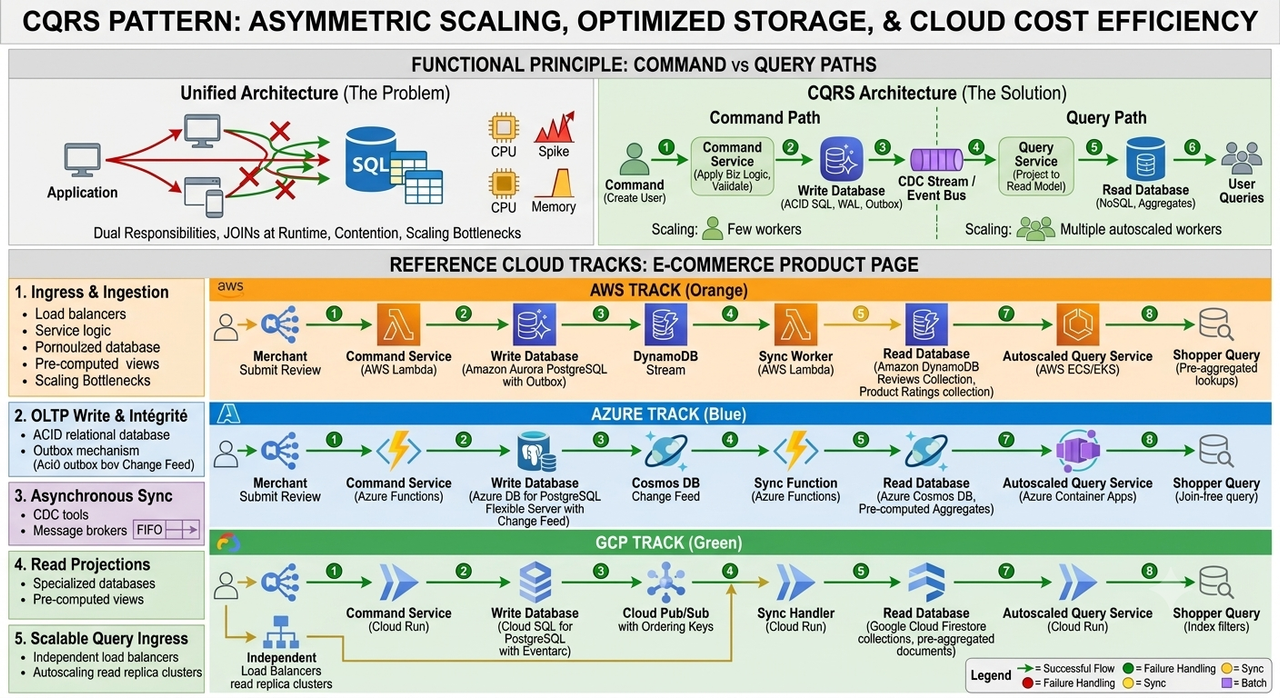
Figure 5: CQRS Pattern: Asymmetric Scaling, Optimized Storage, and Cloud Cost Efficiency across AWS, Azure, and Google Cloud. (Source: Author's own illustration)
5. Deep Dive: Deciphering the CQRS Architecture Infographic
The infographic illustrates the structural mechanics, data pipelines, and multi-cloud infrastructure topologies of the Command and Query Responsibility Segregation (CQRS) pattern. Below is a structured walkthrough of the components, workflows, and comparative cloud tracks shown in the diagram.
1. The Monolithic Dilemma: Why Unified Architectures Fail (Top Left: "The Problem")
In a conventional architecture (represented by the unified blue SQL database model on the left), web applications and mobile clients channel all read and write traffic through a single database instance:
- Runtime Bottlenecks: Throughout the day, thousands of users browse products, generating demanding read queries that require multi-table
JOINoperations and dynamic aggregations over raw relational schemas. - Contention with Critical Writes: Concurrently, customers submit transactions, requiring immediate updates to inventory, orders, and payment records.
- Resource Exhaustion: Because both profiles target the same engine, CPU and memory spike under concurrent load. Long-running analytical scans lock critical table resources, slowing down or timing out latency-sensitive write transactions.
The Concrete E-Commerce Use Case: On any product page, two conflicting operations collide:
- The Command Side (Mutations): Submitting or modifying a customer review requires strict business validation—such as cross-checking the order history via foreign keys to guarantee verified purchase authenticity.
- The Query Side (Retrievals): Shoppers merely want the product details, the latest ten reviews, and the aggregated rating score. Computing averages dynamically over millions of transaction rows degrades performance for every visitor.
2. The Solution: Physical Path Segregation (Top Right: "The Solution")
CQRS eliminates runtime contention by dividing the system into two physically decoupled execution pipelines:
- Circuit A: The Command Path (Left):
- Scope: Handles all state-altering operations (Insert, Update, Delete).
- Architecture: The Command Service routes mutations to a dedicated, write-optimized database (
Write Database: ACID SQL, WAL, Outbox). This tier focuses entirely on domain validations, security checks, and data integrity. - Circuit B: The Query Path (Right):
- Scope: Handles all read-only extraction requests (Query, Fetch).
- Architecture: The Query Service accesses a dedicated, read-optimized store (
Read Database: NoSQL, Aggregates). This tier contains zero mutation logic and returns pre-computed views with sub-millisecond response times.
3. Inter-Service Communication: The Synchronization Pipeline
To synchronize state changes from Circuit A to Circuit B without tight coupling, the architecture incorporates an asynchronous event pipeline (CDC Stream / Event Bus):
- Steps 1 & 2 (The Write Operation): The client issues an action (e.g.,
UserCreatesReviewCommand). The Command Service executes domain validation logic. The record is committed atomically to the local ACID SQL database. - Steps 3 & 4 (The Asynchronous Capture): Upon commit, the change is captured via Change Data Capture (CDC) or a local Outbox table, generating a domain event (e.g.,
ReviewCreatedEvent). A dedicated relay worker pulls this event and publishes it to an ordered messaging backbone (Message Broker). - Steps 5 & 6 (The Query Model Ingestion): The Query Service or background consumer ingests the event from the broker. Instead of computing aggregations at query time, it projects the update directly into the read-optimized NoSQL database by pre-calculating relevant summary fields. When shoppers load the product page, the Query Service performs an indexed key-value lookup (
Filter (cheap)), eliminating runtime joins and heavy processing.
4. Reference Cloud Implementations: Multi-Cloud Technical Mapping
The lower section of the infographic maps each stage of the CQRS lifecycle to production cloud services across AWS, Azure, and GCP:
| Cloud Provider | Step 1: Command Service & ACID Write DB (OLTP) | Step 2: Relay / Sync Worker | Step 3: Message Broker (Event Backbone) | Step 4: NoSQL Read Store / Projections | Step 5: Scalable Query Ingress (Autoscaled Query Service) |
|---|---|---|---|---|---|
| **AWS ** | AWS Lambda + Amazon Aurora PostgreSQL (Transactional business validation) | DynamoDB Streams (Native CDC on the outbox/store) | Amazon SQS/SNS FIFO (Ordered messaging bus) | Amazon DynamoDB (Pre-aggregated review and rating collections) | AWS ECS/EKS (Distributed auto-scaling query clusters) |
| **Azure ** | Azure Functions + Azure DB for PostgreSQL Flexible Server (ACID transactional integrity) | Azure Cosmos DB Change Feed (Real-time log ingestion) | Azure Service Bus FIFO (Ordered queues & topic sessions) | Azure Cosmos DB (Read-optimized NoSQL container) | Azure Container Apps (Elastic read instances scaling to zero) |
| **GCP ** | Cloud Run + Cloud SQL for PostgreSQL (Relational mutations) | Eventarc + Cloud SQL / Firestore Triggers (Data mutation capture) | Google Cloud Pub/Sub (With ordering keys for sequenced delivery) | Google Cloud Firestore / Bigtable (Document-based read models) | Cloud Run (Autoscaled serverless query endpoints) |
6. Deep Dive: Polyglot Persistence and Event Sequencing in CQRS & Materialized View Patterns
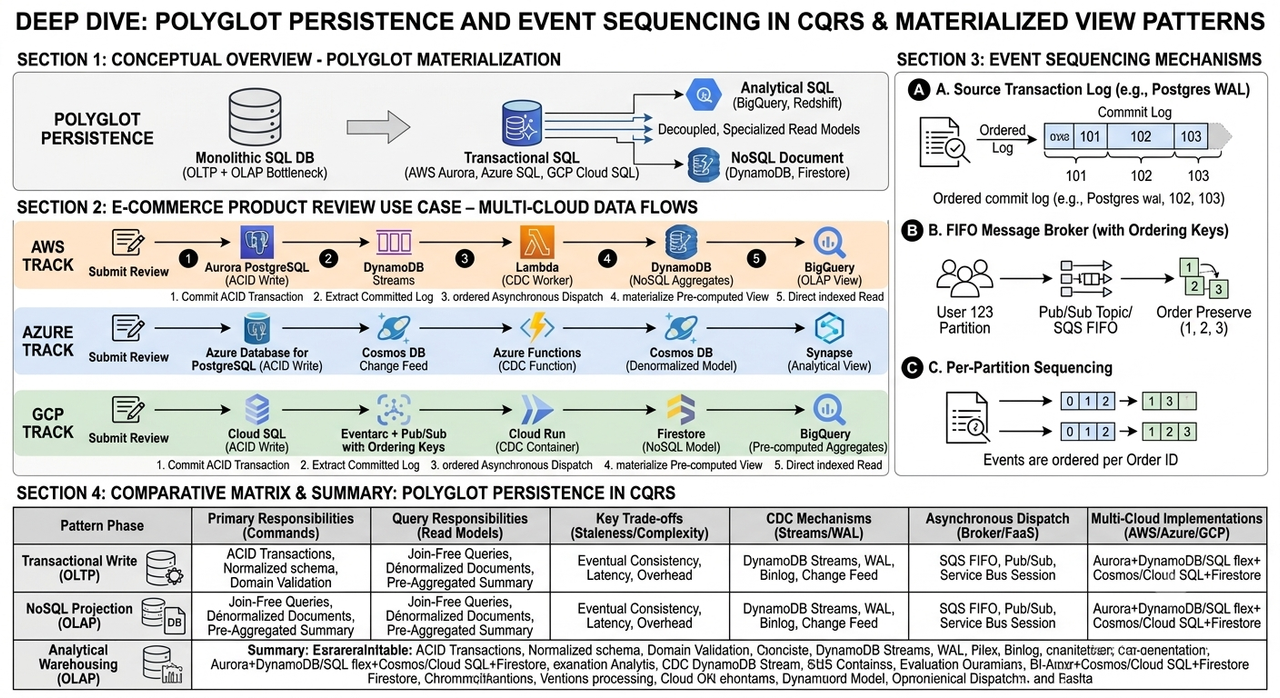
Figure 6: Deep Dive: Polyglot Persistence and Event Sequencing in CQRS & Materialized View Patterns across AWS, Azure, and Google Cloud. (Source: Author's own illustration)
Section 1: Conceptual Overview – Polyglot Materialization
In a traditional monolithic setup, a single SQL database acts as an OLTP and OLAP bottleneck. CQRS resolves this by implementing polyglot persistence: decoupling the primary Transactional SQL store (AWS Aurora, Azure SQL, GCP Cloud SQL) from specialized read models. Data is projected into both high-performance NoSQL Document stores (DynamoDB, Firestore) for low-latency operational queries and Analytical SQL warehouses (BigQuery, Redshift, Synapse) for deep aggregations.
Section 2: E-Commerce Product Review Use Case – Multi-Cloud Data Flows
Across AWS, Azure, and GCP, data traverses a synchronized five-stage pipeline:
- Commit ACID Transaction: The merchant or customer submits a review; the command tier writes it directly into the transactional database (Aurora PostgreSQL, Azure Database for PostgreSQL, Cloud SQL).
- Extract Committed Log: A Change Data Capture (CDC) mechanism (DynamoDB Streams, Cosmos DB Change Feed, Eventarc) tails the commit log without burdening the transactional engine.
- Ordered Asynchronous Dispatch: A serverless worker (Lambda, Azure Functions, Cloud Run container) dispatches the mutation event across an ordered messaging broker.
- Materialize Pre-computed View: The projection worker populates denormalized documents and recalculates rating averages in the read store (DynamoDB, Cosmos DB, Firestore).
- Direct Indexed Read & Analytics: Shoppers query the NoSQL store via direct index lookups, while analytical pipelines replicate aggregates into BigQuery or Azure Synapse.
Section 3: Event Sequencing Mechanisms
To guarantee that downstream read models never reflect state updates out of order, three explicit sequencing safeguards are applied:
- A. Source Transaction Log (e.g., Postgres WAL): The database write-ahead log acts as a strictly ordered, immutable commit log (e.g., commits 101, 102, 103).
- B. FIFO Message Broker (with Ordering Keys): The messaging layer (SQS FIFO, Pub/Sub with Ordering Keys) groups messages by entity partition (e.g.,
User_IDorOrder_ID), preserving relative ordering (1, 2, 3) across the network. - C. Per-Partition Sequencing: Events are delivered and processed per entity ID sequentially, guaranteeing that a
Createevent is never preceded by anUpdateorDelete.
Section 4: Comparative Matrix: Polyglot Persistence in CQRS
| Pattern Phase | Primary Responsibilities (Commands) | Query Responsibilities (Read Models) | Key Trade-offs (Staleness / Complexity) | CDC Mechanisms (Streams / WAL) | Asynchronous Dispatch (Broker / FaaS) | Multi-Cloud Implementations (AWS / Azure / GCP) |
|---|---|---|---|---|---|---|
| Transactional Write (OLTP) | ACID Transactions, Normalized schema, Domain Validation | None (Write-Only path) | Highest consistency, potential connection pool contention | DynamoDB Streams, WAL, Binlog, Change Feed | SQS FIFO, Pub/Sub, Service Bus Session | Aurora / Azure DB for PostgreSQL / Cloud SQL |
| NoSQL Projection (OLAP / Operational Read) | None (Read-Only path) | Join-Free Queries, Denormalized Documents, Pre-Aggregated Summary | Eventual Consistency, Latency, Sync Pipeline Overhead | DynamoDB Streams, Cosmos DB Change Feed, Eventarc | AWS Lambda, Azure Functions, Cloud Run | DynamoDB / Cosmos DB / Cloud Firestore |
| Analytical Warehousing (OLAP) | None (Read-Only path) | Complex historical queries, petabyte-scale aggregation, Business Intelligence | Batch / Micro-batch latency, high storage footprint | Transaction Log Replicators, Managed Storage Connectors | Managed ETL, Eventarc, Data Factory | Amazon Redshift / Azure Synapse / Google BigQuery |
7. Key Takeaways
- Workload Isolation: Intensive read queries cannot lock or degrade mission-critical transactional writes.
- Strict Sequencing (FIFO): Incorporating a FIFO-capable broker guarantees events are processed in historical order, preventing race conditions between creation and mutation events.
- Eventual Consistency: A minimal replication lag is accepted in exchange for high availability and low read latencies.
- Asymmetric Elasticity: The Query Path scales horizontally to absorb massive visitor surges without requiring expensive over-provisioning of the transactional Command Path.
Pattern 6: CQRS + Materialized View Pattern for Microservices
In modern distributed software systems, adhering strictly to the Database-per-Microservice architectural pattern guarantees bounded contexts and isolated domain ownership. However, this isolation introduces a significant structural constraint: relational database join operations (JOIN) across disparate databases are technically impossible. When client interfaces require consolidated data scattered across multiple services, standard approaches fall into performance-degrading anti-patterns.
By combining Command and Query Responsibility Segregation (CQRS) with the Materialized View Pattern and an Event-Driven Architecture (EDA), distributed platforms eliminate cross-service join bottlenecks, providing sub-millisecond query responses while preserving full domain decoupling.
1. The Distributed Join Problem: The "In-Memory Aggregation" Anti-Pattern
When an application requires an aggregated view composed of data residing in distinct services (e.g., Microservice 1 with Base Table 1 and Microservice 2 with Base Table 2), systems without CQRS rely on Programmatic Aggregation:
- Network Latency Amplification: An API Gateway or client frontend issues parallel remote network calls across each independent microservice.
- Database Contention: Each upstream service executes transactional queries against its underlying datastore, incurring repeated disk I/O and query parsing overhead.
- Gateway Resource Exhaustion: The requesting gateway must wait for all dependent responses to return over the network, buffer the datasets in memory, and manually compute intersections, groupings, and join mappings.
- Compounding Points of Failure: If any single dependent microservice experiences transient latency or downtime, the consolidated user view fails completely or suffers unacceptable response times.
2. Core Architecture: CQRS + Materialized View
Rather than assembling distributed datasets on demand, the system pre-joins and pre-populates the required dataset into a dedicated read-only table: the Materialized View, maintained within an isolated Query Database under an autonomous Query Service.
[ Command Plane (OLTP Writes) ]
[ User / Admin ]
      |
      +---> [ Courses Service ]   --> [ Courses DB ]
      |           | (Outbox / CDC)
      |           v
      |      [ Event Bus / FaaS ] --------------------+
      |           ^                                   |
      |           | (Outbox / CDC)                    |
      +---> [ Reviews Service ]   --> [ Reviews DB ]  |
                                                      | (Ordered Streams)
------------------------------------------------------|------------------
[ Query Plane (Pre-Aggregated Reads) ]                |
                                                      v
[ User / Shopper ] --> [ API Gateway ] --> [ Course Search Service ]
                                                  |
                                                  v
                                        [( Course Search DB )]
                                        [  Materialized View ]
Architectural Responsibilities:
- Materialized View Primitive: Pre-computes multi-service schemas into a single flat structure optimized specifically for query filtering.
- CQRS Boundary: Isolates the materialized read store inside an independent microservice infrastructure, ensuring read traffic never degrades transactional write throughput.
- Event-Driven Synchronization: Keeps external read models synchronized with source mutations through either an enterprise Message Broker or serverless Function-as-a-Service (FaaS) stream processors.
3. Event-Driven Synchronization Options: Broker vs. FaaS
To synchronize state changes across independent database engines without causing dual-write race conditions, two cloud-native patterns emerge:
Option A: Enterprise Message Broker Pipeline
- Upstream microservices commit their local transactional mutations (e.g., Price Update or New Review).
- An event payload is published to a centralized Message Broker (e.g., Amazon SQS FIFO, Azure Service Bus, GCP Cloud Pub/Sub).
- The dedicated Query Service ingests messages from the queue and applies targeted updates directly to the Materialized View.
- Updates can run as Immediate Updates (per-event ingestion) or Periodic Batch Updates (windowed delta aggregation).
Option B: Serverless Change Data Capture (FaaS / Cloud Functions)
- Managed serverless routines (Cloud Functions / AWS Lambda) continuously watch database change logs (Postgres WAL, MongoDB Change Streams, DynamoDB Streams).
- The serverless compute instance remains dormant when no database mutations take place, reducing compute expenditure to zero (Scale-to-Zero).
- Upon detecting a write transaction on any base table, the function triggers instantly, executes necessary projection transforms, and writes updates directly into the materialized view table.
4. Real-World Case Study: Online Education Platform
Consider an online learning marketplace hosting thousands of active technical courses with continuous review submissions.
The Domain Breakdown:
- Courses Microservice: Encapsulates domain management for curriculum metadata, containing attributes such as
course_name,course_description, andcourse_price. - Reviews Microservice: Manages learner feedback, persisting records with fields including
student_id,review_text,star_rating, and aggregatereview_count.
The Search Bottleneck:
To render the marketplace search catalog, shoppers require course descriptions alongside average star ratings and total review counts:
- Traditional Approach: The API Gateway receives a
/searchrequest, dispatches parallel HTTP calls to both the Courses Service and Reviews Service, joins the JSON payloads in memory, and formats the response. Under heavy search traffic, API Gateway CPU spikes, thread starvation occurs, and page load latency degrades. - CQRS + Materialized View Approach:
- A dedicated Course Search Service is deployed with an optimized search datastore (Course Search Database).
- The datastore contains a denormalized Materialized View containing combined attributes:
course_id,name,price,average_rating, andreview_count. - Whenever course details mutate or new reviews are submitted, events flow through the broker or FaaS pipeline, incrementally reconciling the search view.
- Search requests routed through the API Gateway target the Course Search Service directly, resolving queries via single indexed lookups without runtime joins or inter-service network hops.
5. Cross-Cloud Implementation Matrix (AWS vs. Azure vs. GCP)
| Functional Tier | Amazon Web Services (AWS) | Microsoft Azure | Google Cloud Platform (GCP) |
|---|---|---|---|
| Command Microservices (OLTP Stores) | Amazon Aurora PostgreSQL / RDS instances per microservice | Azure Database for PostgreSQL Flexible Server instances | Cloud SQL for PostgreSQL / Cloud Spanner per domain |
| Event Pipeline (Broker / FaaS) | Option A: Amazon SNS FIFO + SQS FIFO; Option B: AWS Lambda triggered by DynamoDB Streams or Aurora CDC | Option A: Azure Service Bus Topics with Sessions; Option B: Azure Functions triggered by Cosmos DB Change Feed | Option A: Google Cloud Pub/Sub with Ordering Keys; Option B: Cloud Functions / Cloud Run triggered via Eventarc |
| Materialized View Store (Query DB) | Amazon OpenSearch Service / DynamoDB with projected global secondary indexes | Azure Cosmos DB (Core SQL API) / Azure Cognitive Search | Google Cloud Bigtable / Cloud Firestore / Cloud Search |
| Query Gateway & Consumption | Amazon API Gateway routing directly to containerized Query services on AWS ECS/Fargate | Azure API Management routing to Azure Container Apps instances | Cloud Endpoints / Apigee routing to Google Cloud Run services |
6. Architectural Summary & Trade-off Assessment
The fusion of CQRS and the Materialized View Pattern delivers a reliable architectural blueprint for high-throughput microservice ecosystems:
- Elimination of Distributed Joins: Pre-aggregating multi-service schemas eradicates runtime in-memory joins and eliminates cascading service latencies.
- Independent Scalability: Query workloads (e.g., search portals) scale out on demand across lightweight read replicas without risking connection exhaustion on mission-critical transactional services.
- Embracing Eventual Consistency: Downstream materialized projections operate on an eventually consistent model. While mutations are instantly durable in primary operational stores, propagation pipelines introduce minimal staleness windows—an intentional, optimal trade-off for performant cloud platforms.
7. Technical Deep Dive: CQRS + Materialized Views Distributed Cross-Cloud Pattern
In modern distributed software systems, adhering to the Database-per-Microservice architectural constraint ensures strict domain bounded contexts but eliminates the possibility of executing relational JOIN operations across service boundaries. The CQRS + Materialized View pattern resolves this limitation by asynchronously pre-joining scattered datasets into dedicated, read-optimized schemas. This pipeline enables complex, multi-service queries to execute with sub-millisecond latencies while fully preserving microservice autonomy.
This technical deep dive explores the end-to-end operational architecture, transactional data lifecycles, and cloud-native primitive mappings across three major cloud platforms for two structurally conflicting workloads: synchronous transactional mutations (OLTP) and high-throughput aggregated retrievals (OLAP-lite).
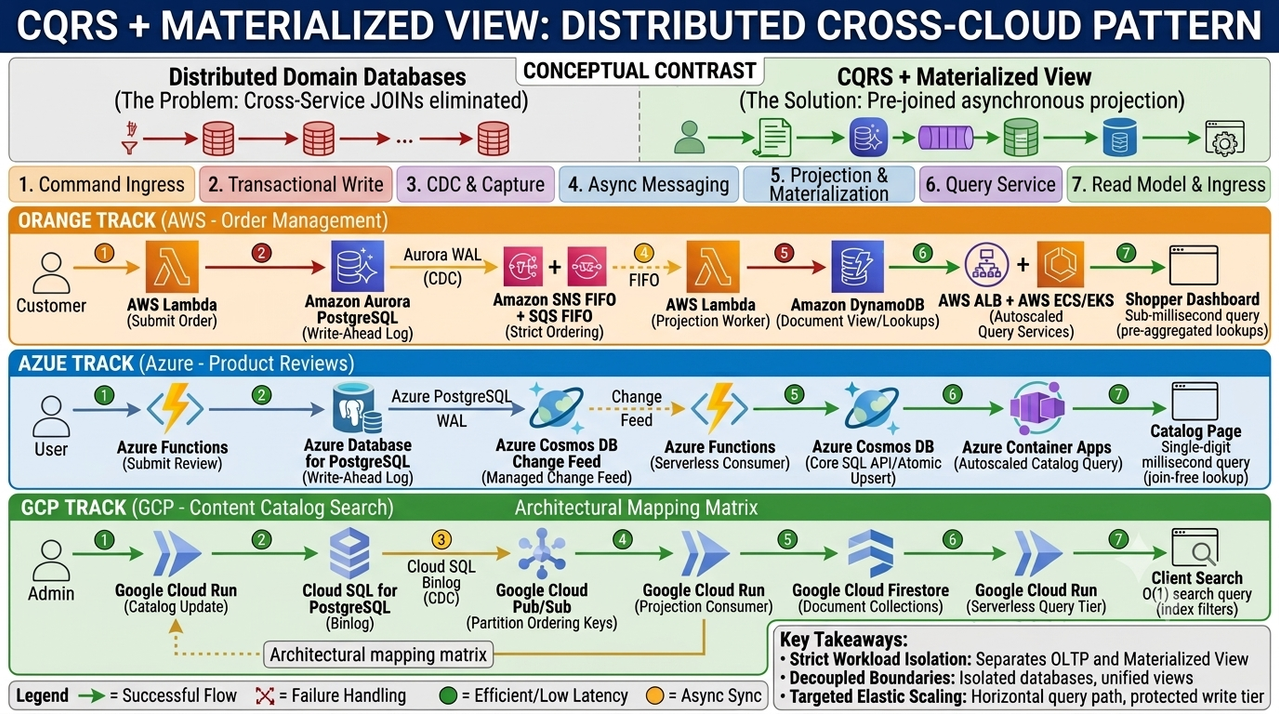
Figure 7: CQRS + Materialized View: Distributed Cross-Cloud Pattern Architecture Across AWS, Azure, and Google Cloud. (Source: Author's own illustration)
1. Multi-Cloud Architectural Deep Dive & Concrete Use Cases
A. AWS Use Case: Order Management with Verified Inventory
- Problem Statement: A high-volume e-commerce platform requires immediate stock verification before committing a customer's order. Executing concurrent catalog lookups and heavy order mutations against a unified database triggers lock contention, elevates transaction latency, and hurts checkout throughput.
- Command Path (Writes):
- The write request hits an AWS Lambda instance executing the validated
Submit Ordercommand. - The function enforces strict domain logic (verifying account posture, processing payments) and commits changes to Amazon Aurora PostgreSQL.
- Aurora enforces local ACID transaction isolation (
ACID Local Tx), with foreign keys validating product existence.
- The write request hits an AWS Lambda instance executing the validated
- Ordered Event Pipeline (EDA):
- Upon successful transactional commit, the resulting
Order Createdstate mutation is extracted directly from the Aurora Write-Ahead Log (WAL) using Change Data Capture (CDC). - The event is routed into an Amazon SNS FIFO topic subscribed to by an Amazon SQS FIFO queue.
- The FIFO pipeline guarantees strict, ordered message processing per
order_id, entirely avoiding concurrent race conditions.
- Upon successful transactional commit, the resulting
- Materialization & Query Path:
- A dedicated projection worker deployed on AWS Lambda consumes the message stream sequentially from SQS FIFO.
- The worker executes transformations (denormalizing customer records and pre-calculating order pricing/tax totals) and writes the output directly into Amazon DynamoDB.
- The underlying document collection is indexed to serve sub-millisecond key-value lookups.
- When shoppers inspect their dashboards, requests route through an AWS Application Load Balancer to autoscaled AWS ECS/EKS query tasks, which query DynamoDB directly without executing runtime joins.
B. Azure Use Case: Product Review and Rating Aggregation
- Problem Statement: A global marketplace receives millions of product page views daily alongside bursts of new product reviews. To render product listings at scale, the user-facing catalog must serve pre-calculated average ratings and total counts without calculating on-the-fly SQL aggregations across millions of raw review records.
- Command Path (Writes):
- Merchants or shoppers submit review mutations handled by an Azure Functions ingress endpoint.
- The function runs domain validations (e.g., authentication verification, verified-buyer validation, anti-spam filters).
- Validated records are committed to an Azure Database for PostgreSQL Flexible Server, which guarantees relational ACID durability.
- Serverless CDC Pipeline:
- Upon commit, updates trigger an event stream consumed via the Azure Cosmos DB Change Feed processor.
- A serverless consumer running on Azure Functions listens directly to this change feed using native triggers.
- This pipeline eliminates external queue maintenance by leveraging a managed, event-driven compute layer that scales to zero during idle periods.
- Materialization & Query Path:
- The serverless function recalculates the product's aggregate star rating, review counter, and formatted preview snippet in memory.
- It applies an atomic Upsert against the read-optimized materialized view stored in Azure Cosmos DB (Core SQL API).
- Catalog queries route to Azure Container Apps clusters that pull the pre-computed views from Cosmos DB via single-digit millisecond document lookups.
C. GCP Use Case: Content Catalog and Search Indexing
- Problem Statement: An online educational platform manages thousands of modular video courses, curriculum summaries, and student ratings. Serving high-throughput catalog searches with faceted filtering (e.g., matching category, minimum star rating, and price bracket) makes live cross-database joins across the Courses DB and Reviews DB untenable.
- Command Path (Writes):
- Administrative updates (such as catalog updates and course pricing adjustments) are ingested by containerized services on Google Cloud Run.
- Mutations are persisted to a primary Cloud SQL for PostgreSQL instance, ensuring strict transactional integrity and relational normalization across core tables.
- Distributed Event Pipeline:
- Modifications committed to Cloud SQL are captured via database binlog CDC integration.
- Events stream asynchronously into Google Cloud Pub/Sub, which utilizes partition ordering keys to guarantee in-sequence downstream delivery.
- Materialization & Query Path:
- A serverless stream consumer running on Google Cloud Run processes inbound Pub/Sub events.
- The consumer compiles the incoming updates into denormalized search documents, pairing course metadata with student rating metrics.
- The resulting documents are persisted to Google Cloud Firestore, a low-latency NoSQL document store with native index support for multi-field filtering.
- Client search queries hit Google Cloud Run query services, which query Firestore directly with O(1) lookup costs and zero operational strain on the upstream transactional database.
2. Multi-Cloud Architecture Mapping Matrix
| Architecture Phase | AWS Track | Azure Track | GCP Track |
|---|---|---|---|
| Command Ingress | AWS Lambda | Azure Functions | Google Cloud Run |
| OLTP Persistence | Amazon Aurora PostgreSQL | Azure DB for PostgreSQL Flexible Server | Cloud SQL for PostgreSQL |
| CDC & Log Capture | Aurora WAL / DynamoDB Streams | Azure PostgreSQL WAL / Cosmos DB Change Feed | Cloud SQL Binlog / Eventarc |
| Event Dispatch / Messaging | Amazon SNS FIFO + SQS FIFO | Azure Service Bus (Topics & Sessions) | Google Cloud Pub/Sub (with Ordering Keys) |
| Projection Engine | AWS Lambda (Sync Worker) | Azure Functions (Projection Logic) | Google Cloud Run (Sync Consumer) |
| Read Model (Materialized View) | Amazon DynamoDB (Document View) | Azure Cosmos DB (Core SQL API) | Google Cloud Firestore (Document Collections) |
| Query Ingress & Compute | AWS ALB + AWS ECS/EKS Clusters | Azure Container Apps (Autoscaled) | Google Cloud Run (Serverless Query Tier) |
3. Key Takeaways & Core Architectural Principles
- Strict Workload Isolation: Separating mutation processing (OLTP) from read-only projections (OLAP-lite) eliminates shared-resource contention and protects write transaction throughput.
- Decoupled Microservice Boundaries: Materialized views remove the need for cross-service distributed joins, allowing individual services to maintain isolated databases while continuing to expose unified, low-latency views.
- Targeted Elastic Scaling: Compute resources for the query path scale out horizontally to absorb unpredictable query spikes without forcing an over-provisioning of the primary transactional database tier.
Pattern 7: Event Sourcing Pattern for High-Performance Distributed Systems
In modern distributed software architectures, conventional relational or NoSQL persistence relies on the destructive paradigm of in-place state overwrites. Standard CRUD operations update rows or documents directly, obliterating the chronological history of intermediate domain mutations and introducing severe transactional lock contention under write-intensive concurrent traffic.
The Event Sourcing Pattern fundamentally redesigns a system's source of truth: instead of mutating and storing current entity state, the architecture captures every transactional mutation as an immutable, strictly ordered, append-only sequence of business events (Event Log). When paired with Command Query Responsibility Segregation (CQRS), this pattern completely eliminates write lock contention, provides native regulatory auditability, and feeds highly specialized materialized read models with sub-millisecond query performance.
1. The CRUD Mutation Bottleneck: The State Overwrite Anti-Pattern
Traditional CRUD architectures treat persistence engines as containers of mutable state. When a domain entity changes, an UPDATE operation unconditionally replaces previous column attributes:
[ App / Worker ] --( Overwrite )--> [ Row: Inventory = 100 ]
                                    (Past State Lost: 200?)
This model introduces severe architectural limitations in distributed environments:
- Irreversible Loss of Business Intent: If an inventory balance reports 100 units at 5:00 PM after starting at 200 units at 8:00 AM, the system cannot determine if this delta represents 100 single-item checkouts, 200 checkouts followed by 100 customer returns, or a bulk inventory adjustment. Business intent and temporal progression are permanently lost.
- Write Lock Contention & Bottlenecks: Under high concurrency (e.g., ticket drops, flash sales, high-frequency ledgers), parallel worker threads attempt to acquire exclusive locks (pessimistic locks or optimistic lock version clashes) on identical rows, cratering throughput and escalating transaction latencies.
- Fragile, Bolt-On Auditing Pipelines: Achieving traceability in CRUD models requires secondary audit tables populated via database triggers or dual-write application logic, introducing severe disk I/O overhead and synchronization failure modes.
2. Core Architecture: The Append-Only Event Store
Event Sourcing replaces destructive state updates with an immutable record of historical domain facts. The operational datastore executes zero UPDATE or DELETE statements; transactions consist entirely of sequential insertions appended to the tail of the log (APPEND-ONLY).
[ Command Plane (Append-Only Writes) ]

[ Client / User ]
       │ (Command: e.g., PlaceOrder, DepositFunds)
       ▼
[ Append Service ] ──( Append Event )──> [ Event Store / Append-Only Log ]
                                                 │ (Immutable Events)
                                                 ├─ Event 1: OrderCreated
                                                 ├─ Event 2: PaymentProcessed
                                                 └─ Event 3: OrderShipped
                                                 │
    ─────────────────────────────────────────────┼──────────────────────────────
    [ Query Plane (Projections via Broker) ]     ▼
                                         [ Message Queue / Stream ]
                                                 │
                                                 ▼
                                         [ Query Service ] ──> [ Read DB / Cache ]
                                                                (Materialized View)
Core Structural Components:
- Append Service (Command Handler): Validates incoming commands against domain business invariants and produces one or more immutable domain events upon success.
- Event Store: A purpose-built, high-throughput datastore optimized for sequential append operations. Each record encapsulates an
aggregate_id, an immutableevent_type, a domain JSON payload, a high-resolution timestamp, and a monotonically increasingsequence_numberenforcing causal ordering. - Event Replay Mechanism: An entity's current state is derived deterministically on demand by streaming its ordered events from the genesis record through to the most recent transaction.
3. State Reconstruction & Snapshotting Strategies
As long-lived aggregate event streams accumulate thousands of discrete entries, computing current state from genesis on every read or command validation introduces unacceptable CPU, network, and disk I/O overhead.
Event Log: [Tx1] -> [Tx2] -> [Tx3] -> [Tx4] -> [Tx5] -> [Tx6]
                      |                         |
                 [Snapshot 1]              [Snapshot 2]
                                                |
                                                v  Replay Delta Only:
                                                +--> [Tx7] -> [Tx8]
- Periodic Snapshotting: At designated intervals (e.g., every N events or scheduled temporal windows), a background projection process materializes the aggregate's computed state into an immutable snapshot document.
- Optimized Delta Replay: To restore current state, the compute tier retrieves only the most recent valid snapshot (e.g., Snapshot 2 at Tx 7) and streams solely subsequent events (Tx 8 and Tx 9), returning reconstitution latency to predictable, bounded $O(1)$ performance.
- Optimistic Concurrency Control (OCC): The append path enforces a strict uniqueness constraint on
(aggregate_id, expected_version). If a concurrent process commits an event under the same sequence version, the incoming write fails immediately without locking the table or stalling database threads.
4. Real-World Case Study: E-Commerce Orders & Financial Ledger
Consider an e-commerce checkout and financial ledger handling bursts of high-volume customer activity:
- Immutable State Progression: An order's lifecycle (Order ID: 10001) persists distinct events sequentially:
OrderPlaced(12:08 PM),PaymentCaptured(12:10 PM), andOrderDispatched(08:03 AM). - Elimination of Lock Bottlenecks: Highly concurrent purchases targeting scarce inventory items do not block on a unified database row; they append sequential
StockReservedevents to the stream without row locking, deadlocks, or thread starvation. - Temporal Auditing & Time-Travel Analytics: The complete event history enables ad-hoc operational intelligence (e.g., isolating a +60% order surge between specific operational windows) and forensic transaction auditing without dedicated ETL pipelines.
5. Cross-Cloud Implementation Matrix (AWS vs. Azure vs. GCP)
| Functional Tier | Amazon Web Services (AWS) | Microsoft Azure | Google Cloud Platform (GCP) |
|---|---|---|---|
| Command Compute | AWS Lambda / AWS Fargate | Azure Functions / Azure Container Apps | Google Cloud Run |
| Append-Only Event Store | Amazon DynamoDB (PK: AggregateID, SK: VersionID) / Amazon Aurora PostgreSQL | Azure Cosmos DB (Core SQL API, Append-Only Partitioning) | Google Cloud Spanner / Google Cloud Firestore |
| Event Streaming / Broker | DynamoDB Streams -> Amazon Kinesis Data Streams / SQS FIFO | Cosmos DB Change Feed -> Azure Event Hubs / Service Bus Topics | Google Cloud Pub/Sub (with Partition Ordering Keys) |
| Snapshot Datastore | Amazon S3 / Amazon MemoryDB for Redis | Azure Blob Storage / Azure Managed Redis | Google Cloud Storage / Cloud Memorystore |
| Materialized Read Store | Amazon DynamoDB / Amazon OpenSearch Service | Azure Cosmos DB / Azure Database for PostgreSQL | Google Cloud Firestore / Cloud Bigtable |
| Query Consumption Tier | AWS Application Load Balancer + AWS ECS (Fargate) | Azure API Management + Azure Container Apps | Cloud Endpoints / Apigee + Google Cloud Run |
6. Architectural Summary & Trade-off Assessment
The convergence of Event Sourcing and CQRS delivers exceptional scalability advantages alongside intentional engineering trade-offs:
- Intrinsic Auditability & Compliance: The event log serves as an indisputable, tamper-evident ledger, ensuring out-of-the-box regulatory compliance, anomaly detection, and exact forensic reproducibility.
- Lock-Free Write Throughput: Converting transactional updates into sequential, append-only streams eliminates shared-lock contention, unleashing maximum horizontal write performance.
- Schema Evolution Complexity (Event Upcasting): Historical events cannot be altered. Evolving domain schemas require deploying in-memory adapters (Upcasters) during event deserialization rather than running standard schema migration scripts.
- Eventual Consistency in Read Projections: Asynchronous propagation across messaging brokers introduces a bounded latency window before appended events reflect across downstream query models.
7. Multi-Cloud Deep Dive & Concrete Use Cases (Infographic Tracks)
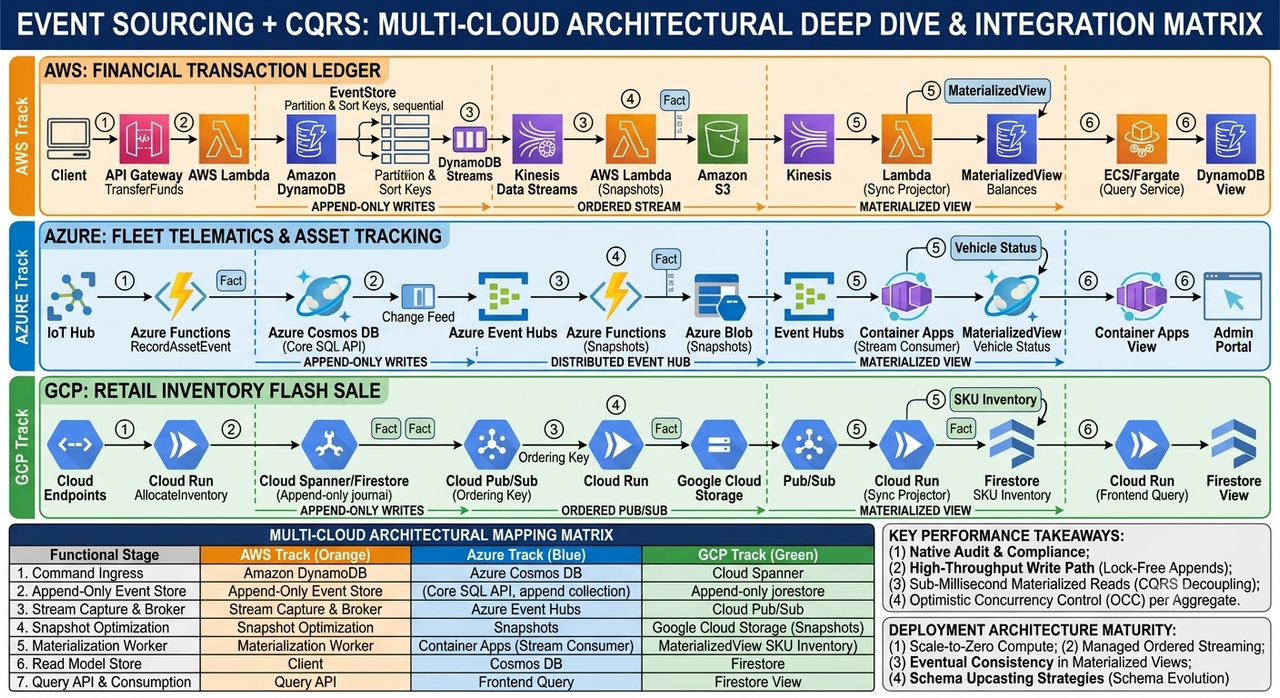
Figure 8: Event Sourcing + CQRS: Multi-Cloud Architectural Deep Dive & Integration Matrix Across AWS, Azure, and Google Cloud. (Source: Author's own illustration)
A. AWS Use Case: Financial Transaction Ledger
- Problem Statement: A mission-critical core banking system requires absolute auditability for high-frequency fund transfers while eliminating lock contention across hot customer accounts during market bursts.
- Command & Append Path (Writes):
- Financial transfer requests route via Amazon API Gateway into AWS Lambda executing the
TransferFundscommand. - Lambda validates account postures and appends an immutable transaction record directly into Amazon DynamoDB (table
EventStore, partitioned byAccount IDwith sequentialVersionIDsort keys).
- Financial transfer requests route via Amazon API Gateway into AWS Lambda executing the
- Streaming & Snapshotting Pipeline: 3. Appended transactions trigger DynamoDB Streams, fanning out into Amazon Kinesis Data Streams for ordered consumption. 4. A dedicated AWS Lambda snapshotting routine captures account states every 50 events and persists immutable checkpoints to Amazon S3.
- Projection & Query Path (Reads): 5. A stream consumer deployed on AWS Lambda (Sync Projector) processes the ordered Kinesis stream and upserts projected balances into a read-optimized Amazon DynamoDB materialized view collection. 6. Account balance inquiries route via an Application Load Balancer to autoscaled AWS ECS (Fargate) query services that pull pre-computed balances in single-digit milliseconds.
B. Azure Use Case: Real-Time Fleet Telematics & Asset Tracking
- Problem Statement: A global logistics fleet streams massive volumes of telemetry and cargo status updates, where concurrent in-place relational row updates cause high database contention and deadlocks.
- Command & Append Path (Writes):
- Fleet IoT tracking units dispatch telemetry beacons through Azure IoT Hub into Azure Functions executing the
RecordAssetEventcommand. - The function validates the payload and commits an append-only event into Azure Cosmos DB (Core SQL API) partitioned by
AssetID.
- Fleet IoT tracking units dispatch telemetry beacons through Azure IoT Hub into Azure Functions executing the
- Distributed Stream & Snapshot Pipeline: 3. Cosmos DB commits are emitted directly via the Cosmos DB Change Feed into Azure Event Hubs for decoupled multi-service consumption. 4. An Azure Functions background worker captures aggregate vehicle states hourly and writes compact binary snapshot objects to Azure Blob Storage.
- Projection & Query Path (Reads): 5. An Azure Container Apps stream processor ingests events from Event Hubs and updates denormalized tracking projections in Azure Cosmos DB (
Materialized View: Vehicle Status). 6. Operational fleet dashboards query pre-computed vehicle positions and status documents via Azure Container Apps query tiers with single-digit millisecond response times.
C. GCP Use Case: Retail Inventory & Flash Sale Allocation
- Problem Statement: An e-commerce marketplace experiences inventory deadlocks and checkout latency spikes during flash sales when thousands of shoppers attempt concurrent updates against a shared inventory table.
- Command & Append Path (Writes):
- Purchase intents enter Cloud Endpoints and hit Google Cloud Run running the
AllocateInventorycommand service. - The service appends an immutable
StockReservedevent to an append-only journal hosted on Google Cloud Spanner / Firestore, completely bypassing row-level locks.
- Purchase intents enter Cloud Endpoints and hit Google Cloud Run running the
- Ordered Pub/Sub & Snapshot Pipeline: 3. Mutations stream into Google Cloud Pub/Sub using partition ordering keys (
Ordering Key: Product_SKU) to guarantee in-sequence downstream delivery. 4. A Google Cloud Run snapshot consumer buffers incoming events and archives aggregate inventory snapshots to Google Cloud Storage. - Projection & Query Path (Reads): 5. A Google Cloud Run (Sync Projector) worker applies event deltas asynchronously to denormalized SKU documents within Google Cloud Firestore. 6. Shopper storefront searches route to containerized Google Cloud Run query services that read pre-computed stock documents directly from Firestore at $O(1)$ lookup speeds.
8. Multi-Cloud Architectural Mapping Matrix
| Architecture Phase | AWS Track (Financial Ledger) | Azure Track (Fleet Telematics) | GCP Track (Retail Inventory) |
|---|---|---|---|
| 1. Command Ingress | AWS Lambda (TransferFunds) |
Azure Functions (RecordAssetEvent) |
Google Cloud Run (AllocateInventory) |
| 2. Append-Only Event Store | Amazon DynamoDB (Partitioned append log) | Azure Cosmos DB (Append collection) | Google Cloud Spanner / Firestore (Journal immuable) |
| 3. Stream Capture & Broker | DynamoDB Streams -> Amazon Kinesis | Cosmos DB Change Feed -> Azure Event Hubs | Google Cloud Pub/Sub (Ordering Keys) |
| 4. Snapshot Optimization | AWS Lambda -> Amazon S3 (Snapshots périodiques) | Azure Functions -> Azure Blob Storage | Cloud Run Consumer -> Google Cloud Storage |
| 5. Materialization Worker | AWS Lambda (Sync Projector) | Azure Container Apps (Stream Consumer) | Google Cloud Run (Sync Projector) |
| 6. Read Model Store | DynamoDB / Aurora Read Replica (Vue Soldes) | Azure DB for PostgreSQL (Vue Télématique) | Google Cloud Firestore (Documents Stock Dénormalisés) |
| 7. Query API & Consumption | AWS ECS (Fargate) + ALB (Client App) | Azure Container Apps (Monitoring Portal) | Google Cloud Run (Catalog Search Frontend) |
Conclusion & Architectural Synthesis
Optimizing data performance across distributed systems is fundamentally an exercise in navigating structural trade-offs: balancing transactional guarantees against write throughput, and immediate consistency against read latency. The seven performance patterns analyzed across this deep dive represent battle-tested implementations of timeless data engineering principles—re-engineered for managed runtimes, serverless compute, and polyglot cloud storage:
- At the batch analytics tier, MapReduce demonstrates the enduring power of decoupled compute and functional data pipelines, processing multi-terabyte datasets cost-effectively through transient worker clusters.
- Across distributed domain boundaries, the Saga Pattern resolves the microservice transactional dilemma, trading rigid, throughput-killing two-phase commit (2PC) locks for autonomous local ACID executions and deterministic compensating workflows.
- To safeguard asynchronous communication, the Transactional Outbox Pattern bridges local transactional durability with distributed event dispatch, providing a rock-solid foundation for at-least-once downstream propagation.
- On the query path, the Materialized View Pattern and CQRS challenge the traditional reliance on a single unified schema. By separating commands from queries and shifting compute overhead from query runtime to asynchronous write-time projection, systems unlock sub-millisecond retrievals while isolating critical OLTP workloads from analytical traffic spikes.
- When scaled across independent microservices, Distributed CQRS with Materialized Views solves the distributed join problem through polyglot persistence, pairing transactional relational stores for mutations with elastic NoSQL document stores for hyper-fast client queries.
- Finally, at the foundational state layer, Event Sourcing abolishes the destructive state overwrite anti-pattern. By adopting an append-only event store, systems unlock lock-free write throughput, absolute regulatory auditability, and time-travel analytics.
Across AWS, Azure, and GCP, cloud vendors provide specialized, enterprise-grade primitives tailored for these architectures—from serverless compute (AWS Lambda, Azure Functions, Google Cloud Run) and managed messaging brokers (Amazon SQS/SNS, Azure Service Bus, Google Cloud Pub/Sub) to distributed event streaming (DynamoDB Streams/Kinesis, Event Hubs, Pub/Sub) and polyglot datastores (Amazon Aurora/DynamoDB, Azure Cosmos DB/PostgreSQL Flexible, Google Cloud Spanner/Firestore/BigQuery).
By grounding distributed system design in these seven architectural patterns, engineering teams transcend brute-force infrastructure scaling. They construct architectures that achieve exceptional write throughput, sub-millisecond retrieval speeds, and uncompromised data integrity under the most demanding data-intensive workloads.
What's Next: Part 3/5
High throughput and transactional consistency form the bedrock of distributed data management, but production architectures must also evolve gracefully alongside changing business requirements, legacy integrations, and heterogeneous client ecosystems.
In the next installment of this series, Part 3/5: Software Extensibility Patterns, we will explore how to isolate peripheral operational concerns, bridge disparate legacy systems without domain corruption, and optimize specialized client communication interfaces through three battle-tested architectural patterns:
- Sidecar & Ambassador Pattern
- Anti-Corruption Layer (ACL) Pattern
- Backends For Frontends (BFF) Pattern
About the author
- Multicloud & AI/ML Engineering Leader, Cloud Architect, and Forward Deployed AI Engineer building enterprise-grade ML, GenAI & Data solutions across AWS, Azure & GCP 🚀 Holding 4x GCP certifications (Professional Cloud Architect, Machine Learning, Data Engineering, GenAI), AWS Professional GenAI Developer, PMP® & CSM®. I bridge cloud architecture, AI product leadership, and agile delivery, with deep expertise in Kubernetes, Docker, cluster deployment, networking, storage & runtime troubleshooting. IBM CodeNet Winner, Call for Code Finalist & WiDS Datathon Winner. 🔥 On this blog, I share architectural breakdowns, hands-on deep dives & MLOps strategies for building resilient pipelines and production-ready GenAI and Agentic AI across multicloud. I also explore the Open GenAI lifecycle: Docker & Ollama workspaces, text/vision data, PEFT/QLoRA & diffusion fine-tuning, rigorous benchmarking, quantization, production RAG, FastAPI/MCP model serving, memory-enabled agents, and AI safety & more
Demystifying Complex Cloud Systems Through Design Patterns
A 5-part engineering deep dive into the architectural patterns governing modern cloud systems -- covering Scalability, Performance, Software Extensibility, Reliability, and Deployment across AWS, Azure, and Google Cloud (GCP).